Ch. 5 - Alkenes: Structure, Nomenclature, and an Introduction to Reactivity • Thermodynamics and Kinetics
Bruice - Organic Chemistry 8th Edition
Bruice8th EditionOrganic ChemistryISBN: 9780135213711Not the one you use?Change textbook
Chapter 6, Problem 63

For a reaction carried out at 25 °C with an equilibrium constant of 1 × 10⁻³, to increase the equilibrium constant by a factor of 10:
a. how much must ∆G° change?
b. how much must ∆H° change if ∆S° = 0 kcal mol-1 K-1?
c. how much must ∆S° change if ∆H° = 0 kcal mol-1?

Verified step by step guidance
1
Step 1: Recall the relationship between the equilibrium constant (K) and the standard Gibbs free energy change (∆G°). The equation is: ∆G° = -RT ln(K), where R is the gas constant (8.314 J/mol·K) and T is the temperature in Kelvin.
Step 2: For part (a), determine how much ∆G° must change to increase the equilibrium constant (K) by a factor of 10. Use the equation ln(K_2/K_1) = -∆G°_change / RT, where K₁ = 1 × 10⁻³ and K₂ = 1 × 10⁻². Solve for ∆G°_change.
Step 3: For part (b), if ∆S° = 0 kcal/mol·K, recall the relationship between ∆G°, ∆H°, and ∆S°: ∆G° = ∆H° - T∆S°. Since ∆S° = 0, the equation simplifies to ∆G° = ∆H°. Use the result from part (a) to determine how much ∆H° must change.
Step 4: For part (c), if ∆H° = 0 kcal/mol, use the same relationship ∆G° = ∆H° - T∆S°. Since ∆H° = 0, the equation simplifies to ∆G° = -T∆S°. Use the result from part (a) to determine how much ∆S° must change.
Step 5: Substitute the known values (R = 8.314 J/mol·K, T = 298 K, and the calculated ∆G°_change from part (a)) into the equations derived in parts (b) and (c) to express the required changes in ∆H° and ∆S°.

Verified video answer for a similar problem:

This video solution was recommended by our tutors as helpful for the problem above.
Video duration:
8m
Was this helpful?

Key Concepts

Here are the essential concepts you must grasp in order to answer the question correctly.

Gibbs Free Energy (∆G°)

Gibbs Free Energy (∆G°) is a thermodynamic potential that indicates the spontaneity of a reaction at constant temperature and pressure. It is calculated using the equation ∆G° = -RT ln(K), where R is the gas constant, T is the temperature in Kelvin, and K is the equilibrium constant. A negative ∆G° indicates a spontaneous reaction, while a positive value suggests non-spontaneity. Understanding how changes in K affect ∆G° is crucial for predicting reaction behavior.
Recommended video:
Guided course
05:02
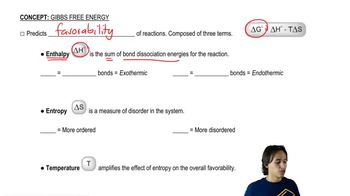
Breaking down the different terms of the Gibbs Free Energy equation.

Enthalpy (∆H°) and Entropy (∆S°)

Enthalpy (∆H°) and Entropy (∆S°) are key thermodynamic properties that influence the Gibbs Free Energy of a reaction. Enthalpy represents the heat content of a system, while entropy measures the disorder or randomness. The relationship between these quantities is described by the Gibbs-Helmholtz equation: ∆G° = ∆H° - T∆S°. Changes in either ∆H° or ∆S° can significantly impact the equilibrium constant and the spontaneity of a reaction.
Recommended video:
Guided course
02:46
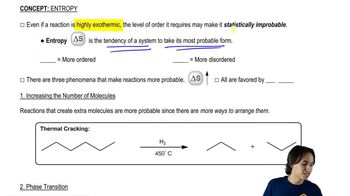
Explaining what entropy is.

Equilibrium Constant (K)

The equilibrium constant (K) quantifies the ratio of the concentrations of products to reactants at equilibrium for a reversible reaction. It is temperature-dependent and reflects the extent to which a reaction proceeds. A higher K value indicates a greater concentration of products at equilibrium, while a lower K suggests more reactants. Understanding how K relates to thermodynamic parameters like ∆G°, ∆H°, and ∆S° is essential for analyzing reaction conditions and predicting shifts in equilibrium.
Recommended video:
Guided course
02:19
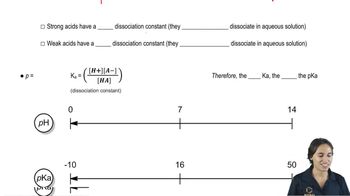
The relationship between equilibrium constant and pKa.