Ch. 5 - Alkenes: Structure, Nomenclature, and an Introduction to Reactivity • Thermodynamics and Kinetics
Bruice - Organic Chemistry 8th Edition
Bruice8th EditionOrganic ChemistryISBN: 9780135213711Not the one you use?Change textbook
Chapter 6, Problem 36

a. Which step in the reaction coordinate diagram shown here has the greatest free energy of activation in the forward direction?
b. Is the first-formed intermediate more apt to revert to reactants or go on to form products?
c. Which step is the rate-determining step of the reaction?
<IMAGE>

Verified step by step guidance
1
Step 1: Analyze the reaction coordinate diagram provided. The diagram shows the energy changes during the reaction progress, with peaks representing transition states and valleys representing intermediates.
Step 2: To determine the step with the greatest free energy of activation in the forward direction (part a), identify the highest peak relative to the preceding valley. The activation energy is the energy difference between the valley and the peak.
Step 3: For part b, examine the first-formed intermediate (the valley after the first peak). Compare its energy level to the reactants and the next transition state. If the intermediate is closer in energy to the reactants, it is more likely to revert to reactants; if closer to the next transition state, it is more likely to proceed to products.
Step 4: For part c, identify the rate-determining step. This is the step with the highest activation energy barrier in the forward direction, as it is the slowest step in the reaction mechanism.
Step 5: Summarize the findings based on the diagram: the greatest activation energy corresponds to the highest peak, the intermediate's stability determines its likelihood to revert or proceed, and the rate-determining step is the one with the largest energy barrier.

Verified video answer for a similar problem:

This video solution was recommended by our tutors as helpful for the problem above.
Video duration:
6m
Was this helpful?

Key Concepts

Here are the essential concepts you must grasp in order to answer the question correctly.

Free Energy of Activation

The free energy of activation (ΔG‡) is the energy barrier that must be overcome for a reaction to proceed. It is represented in a reaction coordinate diagram as the difference in energy between the reactants and the highest point (transition state) along the reaction pathway. The step with the highest peak corresponds to the greatest free energy of activation, indicating it is the slowest step in the reaction.
Recommended video:
Guided course
06:07
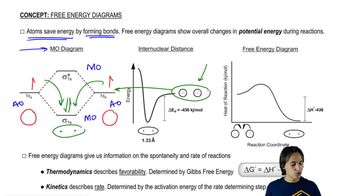
Introduction to free energy diagrams.

Reaction Intermediates

Reaction intermediates are transient species formed during the conversion of reactants to products. Their stability influences the reaction pathway; if an intermediate is more stable than the reactants, it is more likely to proceed to products. Conversely, if it is less stable, it may revert back to the reactants, affecting the overall reaction kinetics and mechanism.
Recommended video:
Guided course
04:31
Stability of Conjugated Intermediates

Rate-Determining Step

The rate-determining step (RDS) is the slowest step in a reaction mechanism that dictates the overall reaction rate. In a reaction coordinate diagram, it is identified as the step with the highest activation energy barrier. Understanding the RDS is crucial for predicting how changes in conditions or reactants will affect the reaction's speed and efficiency.
Recommended video:
5:07
Rates of Intramolecular Reactions Concept 2
Related Practice
Textbook Question

From the Arrhenius equation, predict how

b. increasing the temperature affects the rate constant for a reaction.

1
views

Textbook Question

Draw a reaction coordinate diagram for the following reaction in which C is the most stable and B the least stable of the three species and the transition state going from A to B is more stable than the transition state going from B to C:

a. How many intermediates are there?

b. How many transition states are there?

c. Which step has the greater rate constant in the forward direction?

d. Which step has the greater rate constant in the reverse direction?

2
views
Textbook Question

What is each compound's systematic name?

a.

2
views
Textbook Question

Draw a reaction coordinate diagram for a two-step reaction in which the first step is endergonic, the second step is exergonic, and the overall reaction is endergonic. Label the reactants, products, intermediates, and transition states.

1
views
Textbook Question

Which of the following parameters would be different for a reaction carried out in the presence of a catalyst compared with the same reaction carried out in the absence of a catalyst?

G°, ∆H, Ea, ∆S, ∆H°, Keq, ∆G, ∆S°, k

6
views
Textbook Question

a. Which reaction has a greater equilibrium constant: one with a rate constant of 1 × 10⁻³ sec-1 for the forward reaction and a rate constant of 1 × 10⁻⁵ sec-1 for the reverse reaction, or one with a rate constant of 1 × 10⁻² sec-1 for the forward reaction and a rate constant of 1 × 10⁻³ sec-1 for the reverse reaction?

b. If both reactions start with a reactant concentration of 1.0 M, which reaction will form the most product when the reactions have reached equilibrium?