Ch. 4 - Isomers: The Arrangement of Atoms in Space
Bruice - Organic Chemistry 8th Edition
Bruice8th EditionOrganic ChemistryISBN: 9780135213711Not the one you use?Change textbook
Chapter 5, Problem 71e,f

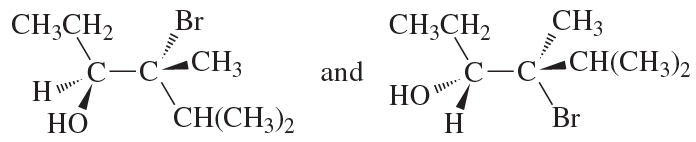
Are the following pairs identical, enantiomers, diastereomers, or constitutional isomers?
e. Structural formulas of two chemical compounds, illustrating their relationships as isomers with specific substituents.
f. Two chemical structures with chlorine atoms, labeled "and," illustrating isomer relationships.

Verified step by step guidance
1
Step 1: Analyze the pair in part (a). Look at the two molecules and identify the stereocenters. Each stereocenter has four different groups attached, and the configuration of these groups determines the stereochemistry.
Step 2: Compare the configurations of the stereocenters in part (a). For each stereocenter, determine whether the groups are arranged in the same way or if they are mirror images. If all stereocenters are mirror images, the molecules are enantiomers. If some stereocenters differ but others are the same, they are diastereomers.
Step 3: Analyze the pair in part (b). These are cyclic structures, specifically chair conformations of cyclohexane derivatives. Examine the substituents and their positions (axial or equatorial) on the rings.
Step 4: Compare the substituents in part (b). If the substituents are arranged differently on the rings, the molecules are constitutional isomers. If the substituents are the same but differ in spatial arrangement, they could be stereoisomers (enantiomers or diastereomers).
Step 5: Summarize the relationships for both pairs. For part (a), determine if the molecules are identical, enantiomers, diastereomers, or constitutional isomers based on stereocenter configurations. For part (b), determine the relationship based on substituent positions and spatial arrangement.

Verified video answer for a similar problem:

This video solution was recommended by our tutors as helpful for the problem above.
Video duration:
8m
Was this helpful?

Key Concepts

Here are the essential concepts you must grasp in order to answer the question correctly.

Stereoisomers

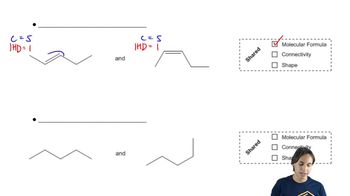
Stereoisomers are compounds that have the same molecular formula and connectivity of atoms but differ in the spatial arrangement of their atoms. This category includes enantiomers and diastereomers, which are crucial for understanding chirality and optical activity in organic molecules.
Recommended video:
Guided course
01:58
Determining when molecules are stereoisomers.

Enantiomers

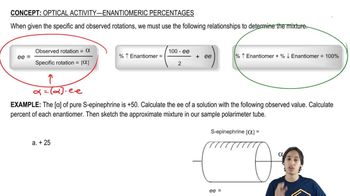
Enantiomers are a specific type of stereoisomer that are non-superimposable mirror images of each other. They typically arise in molecules with chiral centers, where the arrangement of substituents around the chiral carbon leads to two distinct configurations, each exhibiting different optical activity.
Recommended video:
Guided course
03:23
How to solve for the percentage of each enantiomer.

Diastereomers

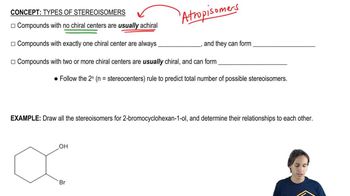
Diastereomers are stereoisomers that are not mirror images of each other. They occur when a molecule has two or more chiral centers, and at least one but not all of the chiral centers differ in configuration. This results in different physical and chemical properties, making diastereomers distinct from enantiomers.
Recommended video:
Guided course
03:44
Using chiral centers to predict types of stereoisomers.