Ch. 4 - Isomers: The Arrangement of Atoms in Space
Bruice - Organic Chemistry 8th Edition
Bruice8th EditionOrganic ChemistryISBN: 9780135213711Not the one you use?Change textbook
Chapter 5, Problem 71c,d

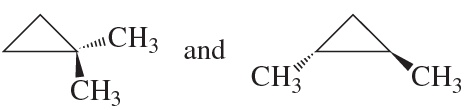
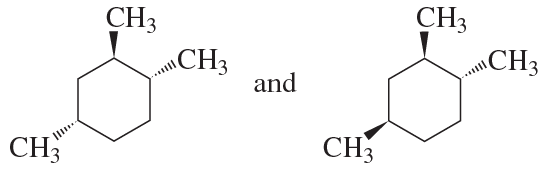
Are the following pairs identical, enantiomers, diastereomers, or constitutional isomers?
c. Two molecular structures are shown, labeled as "and," illustrating a comparison of isomers.
d. Two molecular structures are shown, labeled "and," illustrating a comparison of isomers.

Verified step by step guidance
1
Step 1: Analyze the structures in part (a). Both molecules are cyclobutane derivatives with two chlorine atoms attached. Observe the stereochemistry of the chlorine atoms, indicated by wedge (solid) and dash (dotted) bonds, which represent different spatial orientations.
Step 2: Determine the relationship between the two molecules in part (a). Check if the molecules are mirror images of each other (enantiomers), identical, or if they differ in connectivity (constitutional isomers). If they are stereoisomers but not mirror images, they are diastereomers.
Step 3: Analyze the structures in part (b). Both molecules are cyclopentane derivatives with three chlorine atoms attached. Again, observe the stereochemistry of the chlorine atoms using the wedge and dash bonds.
Step 4: Determine the relationship between the two molecules in part (b). Check if the molecules are mirror images of each other (enantiomers), identical, or if they differ in connectivity (constitutional isomers). If they are stereoisomers but not mirror images, they are diastereomers.
Step 5: Summarize the relationships for both parts (a) and (b) based on the stereochemical analysis. Use the definitions of identical molecules, enantiomers, diastereomers, and constitutional isomers to classify each pair.

Verified video answer for a similar problem:

This video solution was recommended by our tutors as helpful for the problem above.
Video duration:
7m
Was this helpful?

Key Concepts

Here are the essential concepts you must grasp in order to answer the question correctly.

Isomerism

Isomerism refers to the phenomenon where two or more compounds have the same molecular formula but different structural arrangements or spatial orientations. This can lead to different physical and chemical properties. The main types of isomers include constitutional isomers, which differ in connectivity, and stereoisomers, which include enantiomers and diastereomers that differ in spatial arrangement.
Recommended video:
Guided course
06:47
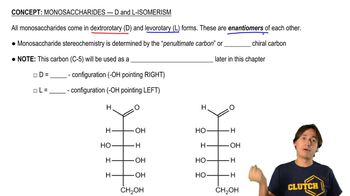
Monosaccharides - D and L Isomerism

Enantiomers

Enantiomers are a type of stereoisomer that are non-superimposable mirror images of each other. They typically arise in molecules with chiral centers, where the arrangement of substituents around the chiral carbon creates two distinct forms. Enantiomers often exhibit different optical activities, meaning they rotate plane-polarized light in opposite directions.
Recommended video:
Guided course
03:23
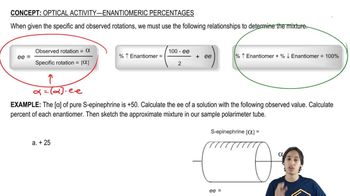
How to solve for the percentage of each enantiomer.

Diastereomers

Diastereomers are stereoisomers that are not mirror images of each other and have different physical properties. They occur when a molecule has two or more chiral centers, leading to multiple stereoisomeric forms. Unlike enantiomers, diastereomers can have different boiling points, melting points, and reactivity, making them significant in organic synthesis and drug design.
Recommended video:
Guided course
03:44
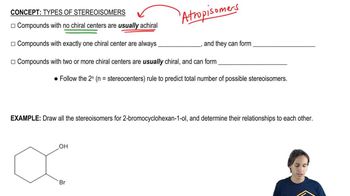
Using chiral centers to predict types of stereoisomers.