Ch. 3 - An Introduction to Organic Compounds:Nomenclature, Physical Properties, and Structure
Bruice - Organic Chemistry 8th Edition
Bruice8th EditionOrganic ChemistryISBN: 9780135213711Not the one you use?Change textbook
Chapter 4, Problem 31a

Predict the approximate size of the following bond angles.
(a) the C—O—C bond angle in an ether

Verified step by step guidance
1
Review the molecular geometry of the ether functional group. In an ether, the central oxygen atom is bonded to two carbon atoms and has two lone pairs of electrons. This gives the oxygen atom a total of four regions of electron density.
Apply the Valence Shell Electron Pair Repulsion (VSEPR) theory. According to VSEPR, the regions of electron density around the oxygen atom will arrange themselves to minimize repulsion. This typically results in a tetrahedral electron geometry.
Understand the impact of lone pairs. Lone pairs of electrons exert greater repulsion than bonding pairs, which slightly compresses the bond angles from the ideal tetrahedral angle of 109.5°.
Estimate the bond angle. Due to the presence of two lone pairs on the oxygen atom, the C—O—C bond angle in an ether is slightly less than 109.5°, typically around 105° to 107°.
Conclude that the approximate bond angle can be predicted based on the tetrahedral geometry and the influence of lone pair repulsion, leading to a slightly reduced angle compared to the ideal tetrahedral value.

Verified video answer for a similar problem:

This video solution was recommended by our tutors as helpful for the problem above.
Was this helpful?

Key Concepts

Here are the essential concepts you must grasp in order to answer the question correctly.

Bond Angles

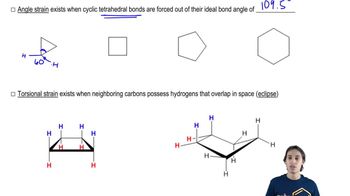
Bond angles are the angles formed between two adjacent bonds at a central atom. They are influenced by the hybridization of the atom and the presence of lone pairs, which can repel bonding pairs and alter the expected angles. Understanding typical bond angles helps predict molecular geometry and reactivity.
Recommended video:
Guided course
02:46
What is angle strain?

Hybridization

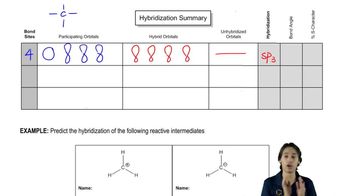
Hybridization is the concept of mixing atomic orbitals to form new hybrid orbitals that can accommodate bonding. In ethers, the carbon atoms are typically sp3 hybridized, leading to a tetrahedral arrangement around each carbon. This hybridization affects the bond angles, which are generally around 109.5 degrees in a tetrahedral geometry.
Recommended video:
Guided course
10:43
Using bond sites to predict hybridization

Molecular Geometry

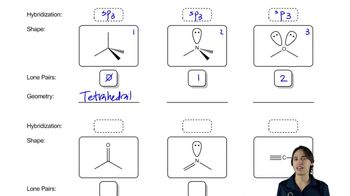
Molecular geometry refers to the three-dimensional arrangement of atoms in a molecule. In the case of ethers, the C—O—C bond angle is influenced by the tetrahedral geometry of the surrounding carbon atoms and the lone pairs on the oxygen atom. This geometry helps predict the physical and chemical properties of the molecule.
Recommended video:
Guided course
07:44
Molecular Geometry Explained.