Ch. 3 - An Introduction to Organic Compounds:Nomenclature, Physical Properties, and Structure
Bruice - Organic Chemistry 8th Edition
Bruice8th EditionOrganic ChemistryISBN: 9780135213711Not the one you use?Change textbook
Chapter 4, Problem 30c

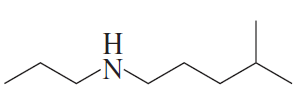
For each of the following, give the systematic name and the common name (if it has one) and then indicate whether it is a primary, secondary, or tertiary amine:
c. Structural formula of an amine with a nitrogen atom bonded to three carbon chains, indicating its classification.

Verified step by step guidance
1
Step 1: Identify the structure of the given amine. Look at the number of alkyl groups attached to the nitrogen atom to determine whether it is a primary, secondary, or tertiary amine. A primary amine has one alkyl group attached to the nitrogen, a secondary amine has two, and a tertiary amine has three.
Step 2: Determine the systematic name of the amine. For this, identify the longest carbon chain attached to the nitrogen atom and name it as an alkyl group. Add the suffix '-amine' to indicate the presence of the amine functional group.
Step 3: Check if the amine has a common name. Common names are often used for simple amines and are based on the alkyl groups attached to the nitrogen. For example, methylamine is the common name for CH3NH2.
Step 4: Confirm the classification of the amine (primary, secondary, or tertiary) based on the number of alkyl groups attached to the nitrogen atom. This classification is important for understanding the reactivity and properties of the compound.
Step 5: Write down both the systematic name and the common name (if applicable), along with the classification of the amine. Ensure that the names and classification are consistent with the structure provided.

Verified video answer for a similar problem:

This video solution was recommended by our tutors as helpful for the problem above.
Video duration:
8m
Was this helpful?

Key Concepts

Here are the essential concepts you must grasp in order to answer the question correctly.

Amines

Amines are organic compounds derived from ammonia (NH3) by replacing one or more hydrogen atoms with alkyl or aryl groups. They are classified based on the number of carbon-containing groups attached to the nitrogen atom: primary amines have one carbon group, secondary amines have two, and tertiary amines have three. Understanding the structure of amines is crucial for naming them systematically and identifying their classification.
Recommended video:
Guided course
07:12
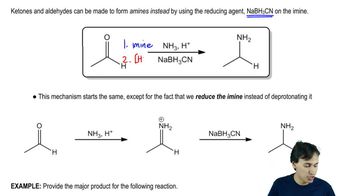
Reductive Amination

Systematic Naming

Systematic naming in organic chemistry follows the IUPAC (International Union of Pure and Applied Chemistry) rules, which provide a standardized method for naming compounds. For amines, the name typically includes the longest carbon chain attached to the nitrogen, with the suffix '-amine' added. This systematic approach helps in accurately identifying the compound's structure and its functional groups.
Recommended video:
Guided course
03:43
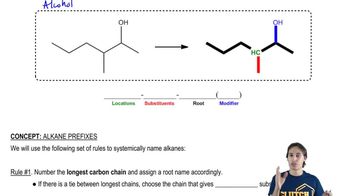
The different parts of an IUPAC name

Common Names

Common names are traditional names used for organic compounds that may not follow systematic naming conventions. They often reflect historical usage or structural features. For example, 'ethylamine' is a common name for a primary amine derived from ethane. Recognizing common names is important for understanding the broader context of organic compounds and their applications.
Recommended video:
Guided course
01:32
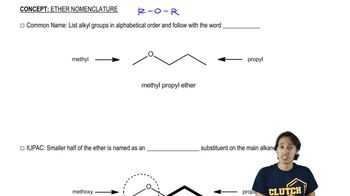
How to name ethers using the common naming system.