Ch. 3 - An Introduction to Organic Compounds:Nomenclature, Physical Properties, and Structure
Bruice - Organic Chemistry 8th Edition
Bruice8th EditionOrganic ChemistryISBN: 9780135213711Not the one you use?Change textbook
Chapter 4, Problem 67c,d

A student was given the structural formulas of several compounds and was asked to give them systematic names. How many did the student name correctly? Correct those that are misnamed.
c. 5-methylcyclohexanol
d. 1,1-dimethyl-2-cyclohexanol

Verified step by step guidance
1
Step 1: Review the IUPAC naming rules for cyclic alcohols. The parent chain should be the cyclohexane ring, and the hydroxyl (-OH) group takes priority in numbering. Substituents are numbered to give the lowest possible locants.
Step 2: Analyze compound c (5-methylcyclohexanol). Check the numbering of the cyclohexane ring to ensure the hydroxyl group is at position 1, as it has the highest priority. If the methyl group is at position 5, verify whether renumbering could result in a lower locant for the substituent.
Step 3: Analyze compound d (1,1-dimethyl-2-cyclohexanol). Confirm that the hydroxyl group is at position 1, as it takes priority. Check the numbering of the dimethyl groups to ensure they are correctly positioned and named according to IUPAC rules. If necessary, renumber the substituents to achieve the lowest locants.
Step 4: Correct any misnamed compounds based on the analysis. For example, if renumbering is required to follow IUPAC rules, update the names accordingly.
Step 5: Compare the corrected names with the original names provided by the student to determine how many were named correctly. Provide feedback on the corrections and explain the reasoning behind the changes.

Verified video answer for a similar problem:

This video solution was recommended by our tutors as helpful for the problem above.
Video duration:
9m
Was this helpful?

Key Concepts

Here are the essential concepts you must grasp in order to answer the question correctly.

IUPAC Nomenclature

IUPAC nomenclature is a systematic method for naming organic chemical compounds. It provides rules for naming based on the structure of the molecule, including the longest carbon chain, functional groups, and substituents. Understanding these rules is essential for accurately naming compounds and identifying their structures.
Recommended video:
Guided course
03:43
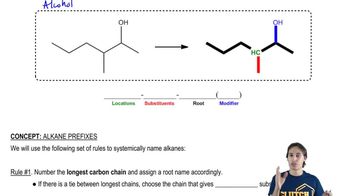
The different parts of an IUPAC name

Functional Groups

Functional groups are specific groups of atoms within molecules that are responsible for the characteristic chemical reactions of those molecules. In the context of alcohols, the hydroxyl group (-OH) is the functional group that defines their properties. Recognizing functional groups is crucial for proper naming and understanding the reactivity of organic compounds.
Recommended video:
Guided course
02:36
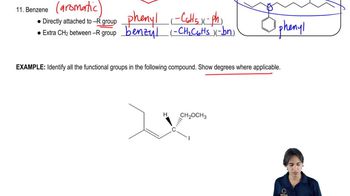
Identifying Functional Groups

Cycloalkanes

Cycloalkanes are saturated hydrocarbons that contain carbon atoms arranged in a ring structure. Their naming involves identifying the ring size and any substituents attached to it. Understanding the structure and naming conventions of cycloalkanes is important for correctly interpreting and naming compounds like cyclohexanol and its derivatives.
Recommended video:
Guided course
01:11
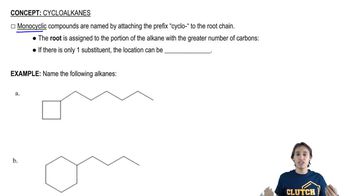
How to find the root name for cycloalkanes