
Ch. 3 - An Introduction to Organic Compounds:Nomenclature, Physical Properties, and Structure
Bruice - Organic Chemistry 8th Edition
Bruice8th EditionOrganic ChemistryISBN: 9780135213711Not the one you use?Change textbook
Chapter 4, Problem 67e,f

A student was given the structural formulas of several compounds and was asked to give them systematic names. How many did the student name correctly? Correct those that are misnamed.
e. 5-(2,2-dimethylethyl)nonane
f. isopentylbromide

Verified step by step guidance
1
Step 1: Understand the IUPAC naming rules. The International Union of Pure and Applied Chemistry (IUPAC) has a systematic set of rules for naming organic compounds. These rules prioritize identifying the longest continuous carbon chain (parent chain), numbering the chain to give substituents the lowest possible numbers, and naming substituents in alphabetical order.
Step 2: Analyze the first compound, 5-(2,2-dimethylethyl)nonane. Identify the parent chain, which is 'nonane' (a 9-carbon chain). The substituent '2,2-dimethylethyl' is attached to the 5th carbon. However, the substituent name '2,2-dimethylethyl' is incorrect because it does not follow the standard naming conventions. The correct name for this substituent is 'tert-butyl'.
Step 3: Correct the name of the first compound. Replace '5-(2,2-dimethylethyl)nonane' with '5-tert-butylnonane', as 'tert-butyl' is the proper name for the substituent.
Step 4: Analyze the second compound, isopentyl bromide. The name 'isopentyl' is a common name and not systematic. To name it systematically, identify the parent chain and substituents. The parent chain is a 5-carbon chain (pentane), and the bromine atom is attached to the second carbon. The correct systematic name is '2-bromopentane'.
Step 5: Summarize the corrections. The first compound should be named '5-tert-butylnonane', and the second compound should be named '2-bromopentane'. These are the systematic IUPAC names for the given compounds.

Verified video answer for a similar problem:

This video solution was recommended by our tutors as helpful for the problem above.
Video duration:
6m
Was this helpful?

Key Concepts

Here are the essential concepts you must grasp in order to answer the question correctly.

IUPAC Nomenclature

IUPAC nomenclature is a systematic method for naming organic chemical compounds. It provides rules for identifying the structure of a compound based on its molecular formula and functional groups. Understanding these rules is essential for accurately naming compounds, as it ensures that each name reflects the compound's structure and composition.
Recommended video:
Guided course
03:43
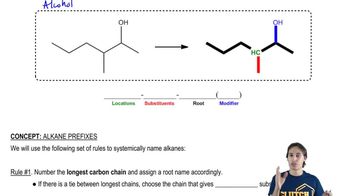
The different parts of an IUPAC name

Alkane Structure

Alkanes are saturated hydrocarbons characterized by single bonds between carbon atoms. Their general formula is CnH2n+2, where 'n' is the number of carbon atoms. Recognizing the structure of alkanes, including branched and straight-chain forms, is crucial for naming them correctly according to IUPAC rules.
Recommended video:
Guided course
02:47
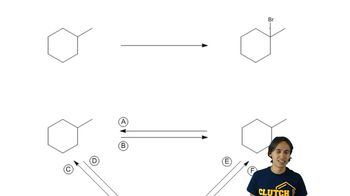
Functionalizing Alkanes

Substituents and Branching

Substituents are groups of atoms that replace hydrogen atoms in a hydrocarbon chain, affecting the compound's name and properties. In naming, the position and type of substituents must be indicated, especially in branched alkanes. Understanding how to identify and name these substituents is vital for providing accurate systematic names.
Recommended video:
Guided course
03:07
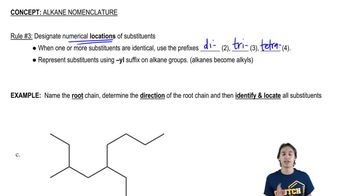
How to identify and locate branches (substituents)