Ch. 28 - Pericyclic Reactions
Bruice - Organic Chemistry 8th Edition
Bruice8th EditionOrganic ChemistryISBN: 9780135213711Not the one you use?Change textbook
Chapter 25, Problem 41

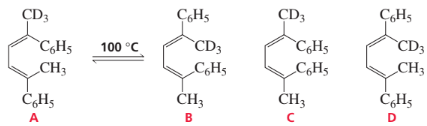
If isomer A is heated to about 100 °C, a mixture of isomers A and B is formed. Explain why there is no trace of isomer C or D.
Chemical structures of isomers A and B with labels, showing a reaction at 100 °C, while isomers C and D are absent.

Verified step by step guidance
1
Analyze the chemical structures of isomers A, B, C, and D. Isomer A and B are structurally similar, differing only in the position of the methyl group and deuterated methyl group. Isomers C and D have different substitution patterns on the aromatic ring.
Consider the reaction conditions: heating to 100 °C. This temperature is sufficient to allow for a reversible equilibrium between isomers A and B, but not for significant bond-breaking or rearrangements that would lead to the formation of isomers C and D.
Examine the mechanism of the isomerization between A and B. The process likely involves a 1,2-shift of the methyl and deuterated methyl groups on the aromatic ring, which is a low-energy pathway under the given conditions.
Explain why isomers C and D are not formed. The formation of C and D would require a complete rearrangement of the substituents on the aromatic ring, which involves breaking and reforming bonds. This is energetically unfavorable under the mild heating conditions provided (100 °C).
Conclude that the equilibrium mixture contains only isomers A and B because the reaction conditions favor simple positional isomerization rather than complex rearrangements that would lead to C and D.

Key Concepts

Here are the essential concepts you must grasp in order to answer the question correctly.

Isomerism

Isomerism refers to the phenomenon where compounds have the same molecular formula but different structural arrangements. In this case, isomers A and B are structural isomers, meaning they differ in the connectivity of their atoms. Understanding isomerism is crucial for predicting the behavior of compounds under different conditions, such as heating.
Recommended video:
Guided course
06:47
Monosaccharides - D and L Isomerism

Thermodynamic Stability

Thermodynamic stability relates to the energy levels of different isomers. Isomers that are lower in energy are more stable and thus favored at equilibrium. The absence of isomers C and D suggests that they are less stable compared to isomers A and B, which can form a mixture when heated, indicating that the reaction favors the formation of the more stable products.
Recommended video:
Guided course
03:43
The radical stability trend.

Reaction Conditions

The conditions under which a reaction occurs, such as temperature, can significantly influence the products formed. Heating isomer A to 100 °C likely provides enough energy to facilitate the conversion to isomer B, while isomers C and D may require different conditions or energy levels to form, explaining their absence in the reaction mixture.
Recommended video:
1:18
EAS Reactions of Pyridine Example 1