Ch. 28 - Pericyclic Reactions
Bruice - Organic Chemistry 8th Edition
Bruice8th EditionOrganic ChemistryISBN: 9780135213711Not the one you use?Change textbook
Chapter 25, Problem 44

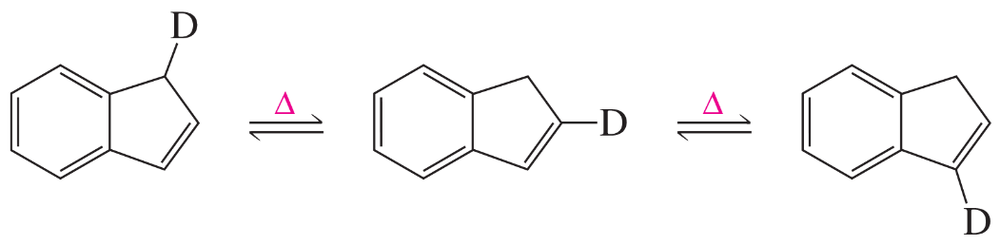
A student found that heating any one of the isomers shown here resulted in scrambling of the deuterium to all three positions on the five-membered ring. Propose a mechanism to account for this observation.

Verified step by step guidance
1
Begin by identifying the structure of the isomers involved. The five-membered ring likely contains a cyclopentane structure with deuterium atoms at specific positions.
Consider the possibility of a reversible reaction mechanism that allows for the migration of deuterium atoms. A plausible mechanism could involve a series of protonation and deprotonation steps.
Propose that the heating of the isomers provides enough energy to overcome the activation barrier for a [1,5]-sigmatropic shift. This type of shift allows for the migration of hydrogen or deuterium atoms across the ring.
Illustrate the mechanism using curved arrows to show the movement of electrons. The deuterium atom can migrate through a series of bond rearrangements, facilitated by the ring's flexibility and the energy provided by heating.
Conclude by explaining that the scrambling of deuterium to all three positions is due to the dynamic equilibrium established by the reversible shifts, allowing deuterium to occupy different positions on the ring over time.

Verified video answer for a similar problem:

This video solution was recommended by our tutors as helpful for the problem above.
Video duration:
1m
Was this helpful?

Key Concepts

Here are the essential concepts you must grasp in order to answer the question correctly.

Isomerism

Isomerism refers to the phenomenon where compounds have the same molecular formula but different structural arrangements or spatial orientations. In organic chemistry, isomers can be classified into structural isomers, which differ in connectivity, and stereoisomers, which differ in the arrangement of atoms in space. Understanding isomerism is crucial for analyzing how different isomers can exhibit distinct chemical behaviors, such as reactivity and stability.
Recommended video:
Guided course
06:47
Monosaccharides - D and L Isomerism

Equilibrium and Reaction Mechanisms

Equilibrium in chemical reactions describes the state where the rates of the forward and reverse reactions are equal, leading to a stable concentration of reactants and products. In the context of the proposed mechanism, understanding how the reaction proceeds through various intermediates and the role of transition states is essential. This knowledge helps explain how deuterium can redistribute among different positions on the ring during heating.
Recommended video:
Guided course
04:00
Determining Acid/Base Equilibrium

Nucleophilic Attack and Proton Transfer

Nucleophilic attack involves a nucleophile (an electron-rich species) attacking an electrophile (an electron-deficient species), often leading to the formation of new bonds. In the context of the scrambling of deuterium, proton transfer may also play a role, where protons are exchanged between different positions on the ring. This process can facilitate the rearrangement of deuterium, allowing it to occupy multiple positions on the five-membered ring.
Recommended video:
Guided course
08:27
Nucleophilic Addition