Ch. 22 - Catalysis in Organic Reactions and in Enzymatic Reactions
Bruice - Organic Chemistry 8th Edition
Bruice8th EditionOrganic ChemistryISBN: 9780135213711Not the one you use?Change textbook
Chapter 23, Problem 29

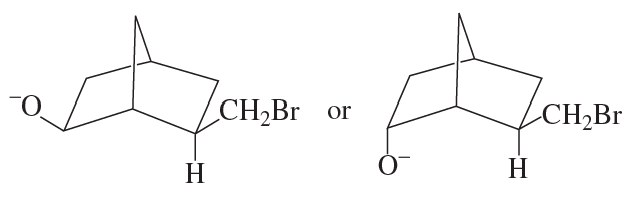
Which of the following two compounds eliminates HBr more rapidly in a basic solution?
Two chemical structures are shown, comparing their rates of HBr elimination in a basic solution.

Verified step by step guidance
1
Step 1: Analyze the structures of the two compounds (a and b). Both compounds contain a chlorine atom attached to a secondary carbon, and an oxygen atom with lone pairs. The elimination of HBr in a basic solution typically follows an E2 mechanism, which requires a strong base and a good leaving group.
Step 2: Consider the stereoelectronic requirements for the E2 elimination mechanism. The β-hydrogen (the hydrogen on the carbon adjacent to the carbon bonded to chlorine) must be anti-periplanar to the leaving group (Cl). This geometry is crucial for the elimination reaction to proceed efficiently.
Step 3: Examine the spatial arrangement of the β-hydrogen and the chlorine atom in both compounds. In compound (a), the β-hydrogen and chlorine are positioned in a way that allows for an anti-periplanar relationship, facilitating elimination. In compound (b), the geometry may be less favorable due to steric hindrance or a lack of proper alignment.
Step 4: Evaluate the effect of the oxygen atom in both compounds. The oxygen atom in compound (a) may stabilize the transition state through its lone pairs, making elimination more favorable. In compound (b), the oxygen atom's position might not contribute as effectively to stabilization.
Step 5: Conclude that the rate of elimination depends on the alignment of the β-hydrogen and chlorine, as well as the stabilization of the transition state. Compound (a) is likely to eliminate HBr more rapidly due to its favorable anti-periplanar geometry and potential stabilization effects.

Verified video answer for a similar problem:

This video solution was recommended by our tutors as helpful for the problem above.
Video duration:
1m
Was this helpful?

Key Concepts

Here are the essential concepts you must grasp in order to answer the question correctly.

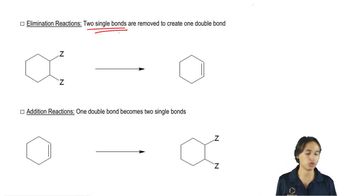
Elimination Reactions

Elimination reactions involve the removal of a small molecule, such as HBr, from a larger molecule, resulting in the formation of a double bond. In organic chemistry, these reactions can occur via different mechanisms, such as E1 or E2, which depend on the structure of the substrate and the reaction conditions. Understanding the mechanism is crucial for predicting the rate of elimination and the stability of the resulting alkenes.
Recommended video:
Guided course
00:40
Recognizing Elimination Reactions.

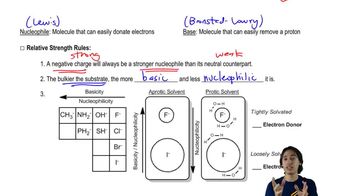
Basic Conditions

Basic conditions in organic reactions typically involve the presence of a strong base, which can facilitate the elimination of hydrogen halides like HBr. In a basic environment, the base can abstract a proton from the substrate, promoting the formation of a double bond. The strength and sterics of the base can significantly influence the reaction pathway and rate, making it essential to consider when analyzing elimination reactions.
Recommended video:
Guided course
06:21
Understanding the difference between basicity and nucleophilicity.

Substituent Effects on Reactivity

The presence and position of substituents on a molecule can greatly affect its reactivity in elimination reactions. Electron-withdrawing groups can stabilize the transition state, while steric hindrance can either facilitate or hinder the elimination process. In the compounds presented, the arrangement of chlorine and hydrogen atoms will influence the rate of HBr elimination, making it important to analyze how these substituents interact with the base during the reaction.
Recommended video:
3:26
Directing Effects in Substituted Pyrroles, Furans, and Thiophenes Concept 2