Which compound has the greatest rate of hydrolysis at pH = 3.5: benzamide, o-carboxybenzamide, o-formylbenzamide, or o-hydroxybenzamide?
Ch. 22 - Catalysis in Organic Reactions and in Enzymatic Reactions
All textbooks
Bruice 8th Edition
Ch. 22 - Catalysis in Organic Reactions and in Enzymatic Reactions
Problem 32a
Bruice 8th Edition
Ch. 22 - Catalysis in Organic Reactions and in Enzymatic Reactions
Problem 32aChapter 23, Problem 32a
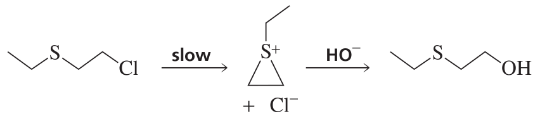
Indicate the type of catalysis that is occurring in the slow step in each of the following reaction sequences:
a. 
Verified step by step guidance1
Identify the slow step in the reaction sequence. The slow step is often referred to as the rate-determining step, which is the step with the highest energy barrier that limits the overall rate of the reaction.
Examine the reactants and products involved in the slow step. Look for any catalysts that are present in the reactants but not in the products, or vice versa, as this can indicate the type of catalysis.
Determine if the catalyst is a substance that provides an alternative reaction pathway with a lower activation energy. This is characteristic of homogeneous catalysis, where the catalyst is in the same phase as the reactants.
Consider if the catalyst is a solid surface that provides a site for the reaction to occur, which is typical of heterogeneous catalysis. In this case, the catalyst is in a different phase than the reactants.
Evaluate if the catalyst is an enzyme or a biological molecule that facilitates the reaction by binding to the reactants. This is indicative of enzymatic catalysis, which is a specific type of homogeneous catalysis.

Verified video answer for a similar problem:
This video solution was recommended by our tutors as helpful for the problem above.
Video duration:
4mWas this helpful?
Key Concepts
Here are the essential concepts you must grasp in order to answer the question correctly.
Catalysis
Catalysis refers to the process of increasing the rate of a chemical reaction by adding a substance known as a catalyst. Catalysts work by providing an alternative reaction pathway with a lower activation energy, allowing the reaction to proceed more quickly. They are not consumed in the reaction and can be used repeatedly.
Recommended video:
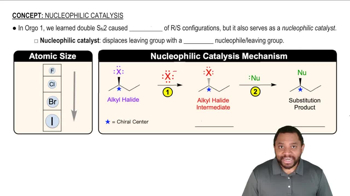
Nucleophilic Catalysis Concept 1
Reaction Mechanism
A reaction mechanism is a detailed description of the step-by-step process by which reactants are converted into products in a chemical reaction. It outlines the individual steps, including the formation and breaking of bonds, and identifies intermediates and transition states. Understanding the mechanism is crucial for determining which step is the rate-determining step.
Recommended video:
Guided course
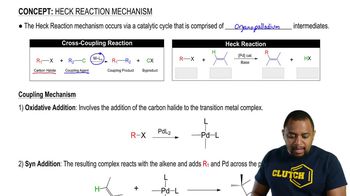
Heck Reaction Mechanism
Rate-Determining Step
The rate-determining step is the slowest step in a reaction mechanism that controls the overall rate of the reaction. It is the bottleneck that limits how quickly the reaction can proceed. Identifying this step is essential for understanding the kinetics of the reaction and the type of catalysis involved.
Recommended video:
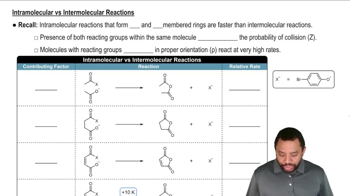
Rates of Intramolecular Reactions Concept 2
Related Practice
Textbook Question
1
views
Textbook Question
Which of the following two compounds eliminates HBr more rapidly in a basic solution?
1
views
Textbook Question
Which compound forms an anhydride more rapidly?
2
views
Textbook Question
The rate constant for the uncatalyzed reaction of two molecules of glycine ethyl ester to form glycylglycine ethyl ester is 0.6 M-1 s-1. In the presence of Co2+, the rate constant is 1.5 × 10⁶ M-1 s-1. What rate enhancement does the catalyst provide?
2
views
Textbook Question
The deuterium kinetic isotope effect (kH2O/kD2O) for the hydrolysis of aspirin is 2.2. What does this tell you about the kind of catalysis exerted by the ortho-carboxyl substituent? (Hint: It is easier to break an O–H bond than an O–D bond.)
1
views
Textbook Question
Indicate the type of catalysis that is occurring in the slow step in each of the following reaction sequences:
b.
1
views