Ch. 2 - Acids and Bases: Central to Understanding Organic Chemistry
Bruice - Organic Chemistry 8th Edition
Bruice8th EditionOrganic ChemistryISBN: 9780135213711Not the one you use?Change textbook
Chapter 3, Problem 66

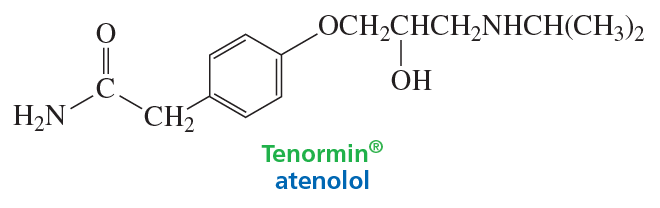
Tenormin, a member of the group of drugs known as beta-blockers, is used to treat high blood pressure and improve survival after a heart attack. It works by slowing down the heart to reduce its workload. Which atom in Tenormin is the most basic?
Chemical structure of Tenormin (atenolol) with labeled atoms, highlighting its components and functional groups.

Verified step by step guidance
1
Step 1: Understand the concept of basicity in organic chemistry. Basicity refers to the ability of an atom to donate a pair of electrons, typically to a proton (H⁺). Atoms with lone pairs of electrons, such as nitrogen, oxygen, or sulfur, are often candidates for basicity.
Step 2: Analyze the structure of Tenormin (Atenolol). Tenormin contains functional groups such as amines, alcohols, and possibly ethers. Focus on identifying atoms with lone pairs of electrons that can act as bases.
Step 3: Evaluate the nitrogen atom in the amine group. Amines are typically more basic than oxygen-containing groups because nitrogen is less electronegative than oxygen, making its lone pair more available for protonation.
Step 4: Consider the environment around the nitrogen atom. If the nitrogen is part of a secondary or tertiary amine, its basicity may be influenced by steric hindrance or electronic effects from nearby groups.
Step 5: Compare the basicity of the nitrogen atom to other atoms in the molecule, such as oxygen in alcohol or ether groups. Oxygen atoms are generally less basic than nitrogen due to their higher electronegativity, which holds onto the lone pair more tightly.

Verified video answer for a similar problem:

This video solution was recommended by our tutors as helpful for the problem above.
Video duration:
3m
Was this helpful?

Key Concepts

Here are the essential concepts you must grasp in order to answer the question correctly.

Basicity in Organic Chemistry

Basicity refers to the ability of a compound to accept protons (H+) or donate electron pairs. In organic chemistry, basicity is influenced by the structure of the molecule, including the presence of electronegative atoms and the availability of lone pairs. A more basic atom typically has a higher electron density and is less hindered by steric factors.
Recommended video:
Guided course
00:56
What is an organic molecule?

Functional Groups in Beta-Blockers

Beta-blockers, like Tenormin, contain specific functional groups that influence their pharmacological properties. Common functional groups include amines, which can act as bases due to the presence of nitrogen atoms with lone pairs. Understanding the functional groups present in Tenormin is crucial for determining which atom may exhibit the highest basicity.
Recommended video:
Guided course
02:36
Identifying Functional Groups

Structure-Activity Relationship (SAR)

The Structure-Activity Relationship (SAR) is a principle that explores how the chemical structure of a compound relates to its biological activity. In the case of Tenormin, analyzing its molecular structure helps identify which atoms contribute to its basicity and overall effectiveness as a beta-blocker. This relationship is essential for predicting how modifications to the structure can affect drug performance.
Recommended video:
4:47
Metal Ion Catalysis: Water Activation Concept 2