Ch. 2 - Acids and Bases: Central to Understanding Organic Chemistry
Bruice - Organic Chemistry 8th Edition
Bruice8th EditionOrganic ChemistryISBN: 9780135213711Not the one you use?Change textbook
Chapter 3, Problem 68a

For each of the following pairs of reactions, indicate which one has the more favorable equilibrium constant (that is, which one most favors products):
1. Chemical equilibrium reactions showing two pairs of acid-base reactions with their respective products and reactants.
2. Chemical equilibrium reactions showing the interaction of ethanol with ammonia and methylamine, indicating product favorability.

Verified step by step guidance
1
Step 1: Understand the problem. The question asks us to compare the equilibrium constants for two pairs of reactions. The equilibrium constant depends on the relative acidity of the acids involved, which can be determined using their pKa values. Lower pKa values indicate stronger acids.
Step 2: Analyze the first pair of reactions: CH3CH2OH + NH3 ⇌ CH3CH2O− + NH4 and CH3OH + NH3 ⇌ CH3O− + NH4. Compare the acidity of CH3CH2OH and CH3OH using their pKa values. CH3CH2OH has a slightly higher pKa than CH3OH, meaning CH3OH is the stronger acid. Therefore, the reaction involving CH3OH will have a more favorable equilibrium constant.
Step 3: Analyze the second pair of reactions: CH3CH2OH + NH3 ⇌ CH3CH2O− + NH4 and CH3CH2OH + CH3NH2 ⇌ CH3CH2O− + CH3NH3+. Compare the acidity of NH4+ and CH3NH3+ using their pKa values. NH4+ has a lower pKa (9.40) compared to CH3NH3+ (10.70), meaning NH4+ is the stronger acid. Therefore, the reaction involving NH4+ will have a more favorable equilibrium constant.
Step 4: Summarize the reasoning. For each pair of reactions, the equilibrium constant favors the reaction where the acid involved is stronger (lower pKa). This is because stronger acids donate protons more readily, driving the equilibrium toward the products.
Step 5: Conclude the comparison. For the first pair, the reaction with CH3OH is more favorable. For the second pair, the reaction with NH4+ is more favorable. Use the provided pKa table to justify these conclusions.

Verified video answer for a similar problem:

This video solution was recommended by our tutors as helpful for the problem above.
Video duration:
4m
Was this helpful?

Key Concepts

Here are the essential concepts you must grasp in order to answer the question correctly.

Equilibrium Constant (K)

The equilibrium constant (K) quantifies the ratio of the concentrations of products to reactants at equilibrium for a reversible reaction. A larger K value indicates a greater favorability for the formation of products, while a smaller K suggests that reactants are favored. Understanding K is crucial for predicting the direction of a reaction and its extent.
Recommended video:
Guided course
02:19
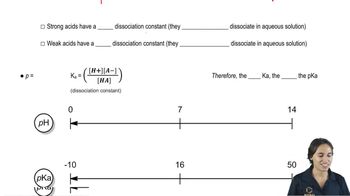
The relationship between equilibrium constant and pKa.

pKa and Acid Strength

pKa is a measure of the strength of an acid in solution; it is the negative logarithm of the acid dissociation constant (Ka). Lower pKa values correspond to stronger acids, which dissociate more completely in solution. In acid-base reactions, the relative pKa values of the acids involved can help predict which direction the equilibrium will favor.
Recommended video:
Guided course
07:45
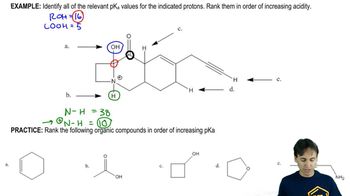
Identifying pKa values

Acid-Base Reactions

Acid-base reactions involve the transfer of protons (H+) from an acid to a base. The strength of the acids and bases involved determines the position of equilibrium. In the context of the given reactions, comparing the pKa values of the acids (like CH3OH and CH3CH2OH) helps to ascertain which reaction will favor product formation more strongly.
Recommended video:
Guided course
02:49
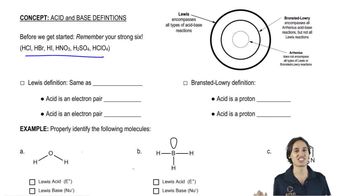
The Lewis definition of acids and bases.