Ch. 2 - Acids and Bases: Central to Understanding Organic Chemistry
Bruice - Organic Chemistry 8th Edition
Bruice8th EditionOrganic ChemistryISBN: 9780135213711Not the one you use?Change textbook
Chapter 3, Problem 74a

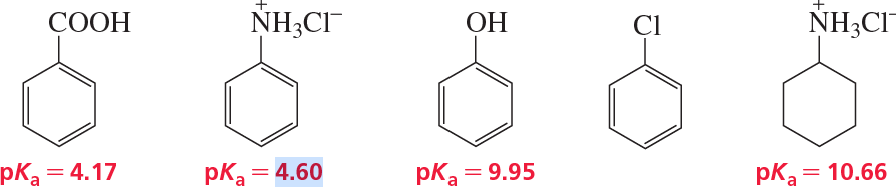
How could you separate a mixture of the following compounds? The reagents available to you are water, ether, 1.0 M HCl, and 1.0 M NaOH.
Chemical structures of compounds with their pKa values: carboxylic acid (4.17), ammonium chloride (4.60), alcohol (9.95), chloride (10.66).

Verified step by step guidance
1
Step 1: Analyze the chemical properties of each compound in the mixture. The compounds include: (1) a carboxylic acid (pKa = 4.8), (2) a protonated amine (pKa = 4.85), (3) a phenol (pKa = 8.6), (4) an alkyl chloride (neutral), and (5) an ammonium salt (pKa = 10.7). These pKa values indicate their relative acidity or basicity, which will guide the separation process.
Step 2: Use 1.0 M NaOH to selectively deprotonate the carboxylic acid (pKa = 4.8) and phenol (pKa = 8.6). The carboxylic acid will form a carboxylate anion, which is water-soluble, while the phenol will also form a phenoxide anion, which is water-soluble. The other compounds will remain in the ether layer.
Step 3: Extract the aqueous layer containing the carboxylate and phenoxide ions. To separate these two compounds, acidify the aqueous layer with 1.0 M HCl. The carboxylate anion will revert to the carboxylic acid, which is insoluble in water and can be extracted into ether. The phenoxide ion will revert to phenol, which can also be extracted into ether.
Step 4: Use 1.0 M HCl to protonate the ammonium salt (pKa = 10.7) and the protonated amine (pKa = 4.85). The ammonium salt is already water-soluble, but the protonated amine will also become water-soluble. These compounds can be extracted into the aqueous layer, leaving the neutral alkyl chloride in the ether layer.
Step 5: Separate the aqueous layer containing the ammonium salt and protonated amine. To isolate the protonated amine, neutralize the aqueous layer with 1.0 M NaOH. The amine will revert to its neutral form and can be extracted into ether. The ammonium salt remains in the aqueous layer.

Verified video answer for a similar problem:

This video solution was recommended by our tutors as helpful for the problem above.
Video duration:
12m
Was this helpful?

Key Concepts

Here are the essential concepts you must grasp in order to answer the question correctly.

Acid-Base Properties

Understanding the acid-base properties of compounds is crucial for separation techniques. The pKa values indicate the strength of acids and bases; lower pKa values correspond to stronger acids. This knowledge helps predict how compounds will behave in acidic or basic environments, guiding the choice of reagents for effective separation.
Recommended video:
2:07
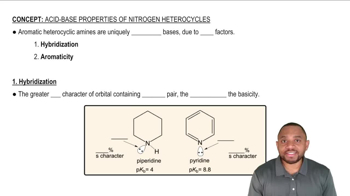
Acid-Base Properties of Nitrogen Heterocycles Concept 1

Solubility and Extraction

Solubility plays a key role in separating compounds using solvents like water and ether. Compounds with different polarities will preferentially dissolve in different solvents, allowing for their separation. For instance, organic compounds may dissolve in ether while ionic compounds may be more soluble in water, facilitating extraction based on solubility differences.
Recommended video:
Guided course
02:01
Introducing common solvents and other molecules in organic chemistry.

Reagent Selection

The choice of reagents, such as 1.0 M HCl and 1.0 M NaOH, is essential for manipulating the ionization states of compounds. Acidic or basic conditions can convert neutral compounds into their ionic forms, enhancing their solubility in water. This principle is vital for separating compounds based on their acid-base characteristics and solubility in different solvents.
Recommended video: