Ch. 2 - Acids and Bases: Central to Understanding Organic Chemistry
Bruice - Organic Chemistry 8th Edition
Bruice8th EditionOrganic ChemistryISBN: 9780135213711Not the one you use?Change textbook
Chapter 3, Problem 76b

At what pH does 80% of the acid exist in its acidic form?

Verified step by step guidance
1
Identify the relationship between the acidic form (HA) and its conjugate base (A⁻) using the Henderson-Hasselbalch equation: \( \text{pH} = \text{pKa} + \log \left( \frac{[A^-]}{[HA]} \right) \).
Determine the ratio of \([A^-]\) to \([HA]\) based on the problem statement. If 80% of the acid exists in its acidic form (HA), then \([HA] = 0.8\) and \([A^-] = 0.2\). The ratio \( \frac{[A^-]}{[HA]} \) is \( \frac{0.2}{0.8} = 0.25 \).
Substitute the ratio \( \frac{[A^-]}{[HA]} = 0.25 \) into the Henderson-Hasselbalch equation: \( \text{pH} = \text{pKa} + \log(0.25) \).
Simplify \( \log(0.25) \) using logarithmic properties: \( \log(0.25) = \log(1/4) = \log(1) - \log(4) = 0 - \log(4) = -\log(4) \).
Combine the simplified logarithmic term with the \( \text{pKa} \) to express the pH: \( \text{pH} = \text{pKa} - \log(4) \). This is the pH at which 80% of the acid exists in its acidic form.

Verified video answer for a similar problem:

This video solution was recommended by our tutors as helpful for the problem above.
Video duration:
6m
Was this helpful?

Key Concepts

Here are the essential concepts you must grasp in order to answer the question correctly.

Acid-Base Equilibrium

Acid-base equilibrium refers to the balance between the concentrations of an acid and its conjugate base in a solution. This equilibrium is influenced by the pH of the solution, which determines the degree of ionization of the acid. Understanding this concept is crucial for determining the proportions of acidic and basic forms of a substance at a given pH.
Recommended video:
Guided course
04:00
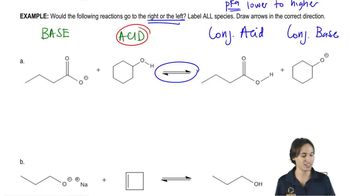
Determining Acid/Base Equilibrium

Henderson-Hasselbalch Equation

The Henderson-Hasselbalch equation is a mathematical formula that relates the pH of a solution to the pKa of an acid and the ratio of the concentrations of its deprotonated (base) and protonated (acid) forms. It is expressed as pH = pKa + log([A-]/[HA]). This equation is essential for calculating the pH at which a specific percentage of an acid exists in its acidic form.
Recommended video:
Guided course
05:02
Breaking down the different terms of the Gibbs Free Energy equation.

Percent Ionization

Percent ionization is a measure of the extent to which an acid dissociates into its ions in solution. It is calculated as the ratio of the concentration of ionized acid to the initial concentration of the acid, multiplied by 100. Knowing the percent ionization helps in understanding how much of the acid exists in its acidic form versus its ionized form at a specific pH.
Recommended video:
Guided course
04:28
Ionization Potentials