Ch. 19 - More About Amines • Reactions of Heterocyclic Compounds
Bruice - Organic Chemistry 8th Edition
Bruice8th EditionOrganic ChemistryISBN: 9780135213711Not the one you use?Change textbook
Chapter 20, Problem 3

Why is the conjugate acid of morpholine more acidic than the conjugate acid of piperidine?

Verified step by step guidance
1
Step 1: Understand the structural differences between morpholine and piperidine. Morpholine contains an oxygen atom in its ring structure, whereas piperidine is a simple six-membered ring with only nitrogen and carbon atoms.
Step 2: Analyze the electronic effects of the oxygen atom in morpholine. The oxygen atom is more electronegative than nitrogen and carbon, which means it can withdraw electron density from the nitrogen atom in the ring. This makes the nitrogen in morpholine less basic compared to the nitrogen in piperidine.
Step 3: Relate the basicity of the nitrogen atom to the acidity of the conjugate acid. A less basic nitrogen atom will result in a more acidic conjugate acid because the protonated form (conjugate acid) is more stable due to the lower electron density around the nitrogen.
Step 4: Consider the inductive effect of the oxygen atom in morpholine. The oxygen atom stabilizes the positive charge on the nitrogen in the conjugate acid through its electron-withdrawing inductive effect, further increasing the acidity of the conjugate acid of morpholine.
Step 5: Compare this to piperidine, which lacks the electron-withdrawing oxygen atom. The nitrogen in piperidine is more basic, and its conjugate acid is less stable, making it less acidic compared to the conjugate acid of morpholine.

Verified video answer for a similar problem:

This video solution was recommended by our tutors as helpful for the problem above.
Video duration:
4m
Was this helpful?

Key Concepts

Here are the essential concepts you must grasp in order to answer the question correctly.

Acidity and pKa

Acidity in organic chemistry is often measured using the pKa value, which indicates the strength of an acid. A lower pKa value corresponds to a stronger acid, meaning it more readily donates protons (H+). Understanding pKa is crucial for comparing the acidity of different compounds, such as the conjugate acids of morpholine and piperidine.
Recommended video:
Guided course
07:45
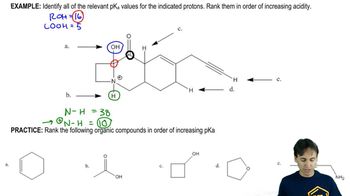
Identifying pKa values

Conjugate Acids

A conjugate acid is formed when a base accepts a proton. In the context of morpholine and piperidine, their conjugate acids differ in stability, which affects their acidity. The stability of a conjugate acid can be influenced by factors such as resonance and inductive effects, which play a significant role in determining the overall acidity of the compound.
Recommended video:
Guided course
03:27
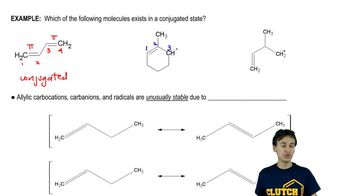
Conjugated states

Resonance and Inductive Effects

Resonance refers to the delocalization of electrons across adjacent atoms, which can stabilize a conjugate acid. Inductive effects involve the influence of electronegative atoms or groups that can withdraw electron density, affecting acidity. In comparing morpholine and piperidine, the presence of electron-withdrawing groups or resonance structures can explain why one conjugate acid is more acidic than the other.
Recommended video:
Guided course
01:47
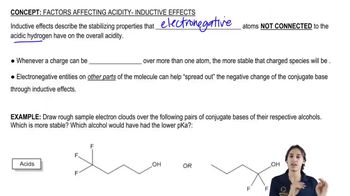
Understanding the Inductive Effect.