Ch. 19 - More About Amines • Reactions of Heterocyclic Compounds
Bruice - Organic Chemistry 8th Edition
Bruice8th EditionOrganic ChemistryISBN: 9780135213711Not the one you use?Change textbook
Chapter 20, Problem 5d

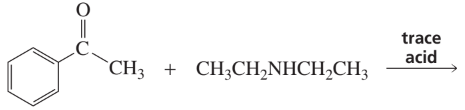
Draw the product of each of the following reactions:
d.

Verified step by step guidance
1
Step 1: Identify the reactants. The left structure is a ketone (2-pentanone), and the right structure is an amine (ethylamine). The reaction occurs in the presence of HCl, which acts as a catalyst.
Step 2: Recognize the type of reaction. This is an imine formation reaction, where a ketone reacts with a primary amine under acidic conditions to form an imine.
Step 3: Understand the mechanism. The ketone undergoes nucleophilic attack by the amine, forming a tetrahedral intermediate. Protonation and dehydration follow, leading to the formation of the imine.
Step 4: Predict the product structure. Replace the oxygen of the ketone with the nitrogen from the amine, and attach the ethyl group to the nitrogen. The double bond forms between the carbon and nitrogen.
Step 5: Verify the stereochemistry and connectivity. Ensure the carbon-nitrogen double bond is correctly placed, and the ethyl group is bonded to the nitrogen atom in the final imine product.

Verified video answer for a similar problem:

This video solution was recommended by our tutors as helpful for the problem above.
Video duration:
5m
Was this helpful?

Key Concepts

Here are the essential concepts you must grasp in order to answer the question correctly.

Imine Formation

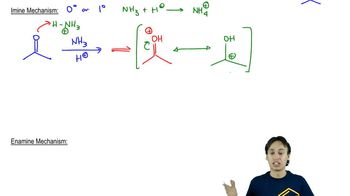
Imine formation occurs when a carbonyl compound, such as an aldehyde or ketone, reacts with an amine. The reaction involves the nucleophilic attack of the amine on the carbonyl carbon, leading to the formation of a tetrahedral intermediate. This intermediate then loses a water molecule, resulting in the formation of an imine, characterized by a C=N bond.
Recommended video:
Guided course
06:23
Imine Mechanism

Enamine Formation

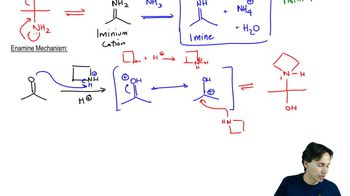
Enamines are formed when a carbonyl compound reacts with a secondary amine. Similar to imine formation, the amine attacks the carbonyl carbon, forming a tetrahedral intermediate. However, in this case, the intermediate undergoes dehydration to yield an enamine, which features a C=C bond adjacent to a nitrogen atom, providing unique reactivity in organic synthesis.
Recommended video:
Guided course
06:25
Enamine Mechanism

Role of HCl in Reactions

Hydrochloric acid (HCl) serves as a catalyst in the formation of imines and enamines by protonating the carbonyl oxygen. This protonation increases the electrophilicity of the carbonyl carbon, facilitating the nucleophilic attack by the amine. Additionally, HCl can help drive the dehydration step, promoting the formation of the final imine or enamine product.
Recommended video:
Guided course
05:09
Heck Reaction