Ch. 18 - Reactions of Benzene and Substituted Benzenes
Bruice - Organic Chemistry 8th Edition
Bruice8th EditionOrganic ChemistryISBN: 9780135213711Not the one you use?Change textbook
Chapter 19, Problem 87c

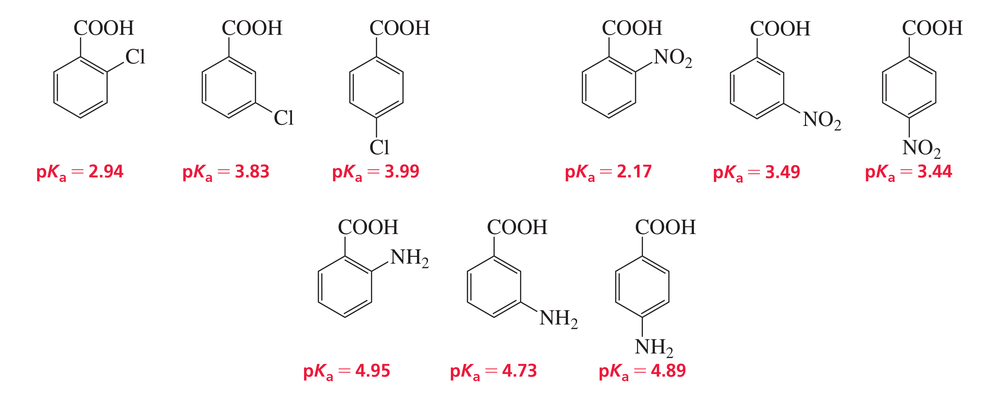
The pKa values of a few ortho-, meta-, and para-substituted benzoic acids are shown below:

The relative pKa values depend on the substituent. For chloro-substituted benzoic acids, the ortho isomer is the most acidic and the para isomer is the least acidic; for nitro-substituted benzoic acids, the ortho isomer is the most acidic and the meta isomer is the least acidic; and for amino-substituted benzoic acids, the meta isomer is the most acidic and the ortho isomer is the least acidic. Explain these relative acidities.
c. NH2: meta > para > ortho

Verified step by step guidance
1
Step 1: Understand the relationship between pKa and acidity. A lower pKa value indicates a stronger acid, meaning the compound is more likely to donate a proton. Analyze the substituent effects on the benzoic acid derivatives provided in the image.
Step 2: Examine the amino-substituted benzoic acids (NH2 group). The pKa values are as follows: ortho (4.95), meta (4.73), and para (4.89). The meta isomer is the most acidic (lowest pKa), followed by para, and then ortho.
Step 3: Consider the electronic effects of the NH2 group. The amino group is an electron-donating group due to its lone pair of electrons, which can participate in resonance. This electron donation stabilizes the carboxylate anion formed after deprotonation, but the extent of stabilization depends on the position of the substituent.
Step 4: For the ortho isomer, steric hindrance between the NH2 group and the carboxylic acid group reduces the effectiveness of resonance stabilization. Additionally, intramolecular hydrogen bonding may occur, which can reduce the acidity of the carboxylic acid group.
Step 5: For the meta and para isomers, steric hindrance is minimized. The meta position does not allow direct resonance interaction between the NH2 group and the carboxylic acid group, but inductive effects dominate, making it slightly more acidic than the para isomer. The para position allows resonance interaction, but the electron-donating effect of NH2 reduces the overall acidity compared to the meta isomer.

Verified video answer for a similar problem:

This video solution was recommended by our tutors as helpful for the problem above.
Video duration:
5m
Was this helpful?

Key Concepts

Here are the essential concepts you must grasp in order to answer the question correctly.

Acidity and pKa

Acidity in organic chemistry refers to the ability of a compound to donate a proton (H+). The strength of an acid is often quantified by its pKa value, which is the negative logarithm of the acid dissociation constant (Ka). A lower pKa value indicates a stronger acid, meaning it more readily donates protons. Understanding the relationship between pKa and acidity is crucial for analyzing the relative acidities of substituted benzoic acids.
Recommended video:
Guided course
07:45
Identifying pKa values

Substituent Effects

The presence of different substituents on a benzene ring can significantly influence the acidity of benzoic acids. Electron-withdrawing groups (EWGs), such as nitro (NO2) and chloro (Cl), stabilize the negative charge on the conjugate base, enhancing acidity. Conversely, electron-donating groups (EDGs), like amino (NH2), destabilize the conjugate base, reducing acidity. The position of these substituents (ortho, meta, para) also affects their influence on acidity due to steric and electronic interactions.
Recommended video:
2:02
Directing Effects in Substituted Pyrroles, Furans, and Thiophenes Concept 1

Ortho, Meta, and Para Positioning

The positioning of substituents on the benzene ring—ortho (adjacent), meta (one carbon apart), and para (opposite)—affects the acid strength of benzoic acids. For example, ortho-substituted acids may experience steric hindrance or intramolecular interactions that can either stabilize or destabilize the conjugate base. This positioning leads to variations in acidity, as seen in the provided data, where ortho, meta, and para isomers exhibit different pKa values based on the nature of the substituent.
Recommended video:
Guided course
04:42
Ortho, Para major products