Ch. 18 - Reactions of Benzene and Substituted Benzenes
Bruice - Organic Chemistry 8th Edition
Bruice8th EditionOrganic ChemistryISBN: 9780135213711Not the one you use?Change textbook
Chapter 19, Problem 88a

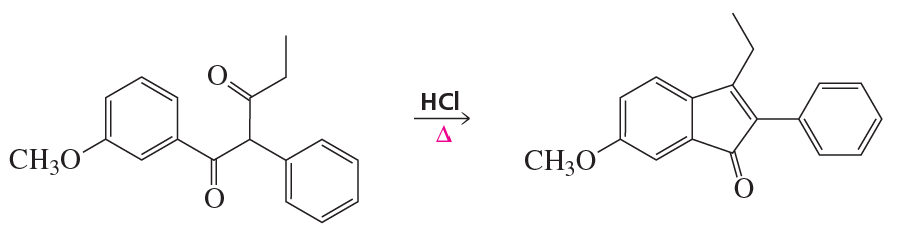
Propose a mechanism for each of the following reactions:
a. Chemical reaction diagram showing reactants and products with HCl catalyst and heat symbol.

Verified step by step guidance
1
Step 1: Analyze the starting material and product. The starting material contains a methoxy-substituted aromatic ring and a diketone structure. The product is a fused bicyclic compound with a ketone and an aromatic ring. This suggests a mechanism involving cyclization and aromatic stabilization.
Step 2: Protonation of the carbonyl group. In the presence of HCl, the carbonyl oxygen of one of the ketones is protonated, increasing its electrophilicity and making the adjacent carbon more susceptible to nucleophilic attack.
Step 3: Intramolecular nucleophilic attack. The aromatic ring, activated by the methoxy group, acts as a nucleophile. The electron-rich aromatic ring attacks the electrophilic carbon of the protonated carbonyl group, forming a new C-C bond and initiating cyclization.
Step 4: Rearrangement and loss of water. After cyclization, a rearrangement occurs to stabilize the intermediate. This may involve the loss of a water molecule (dehydration) to form the final conjugated bicyclic structure.
Step 5: Deprotonation and aromatic stabilization. The final step involves deprotonation to restore aromaticity in the ring system, yielding the stable bicyclic ketone product.

Verified video answer for a similar problem:

This video solution was recommended by our tutors as helpful for the problem above.
Video duration:
3m
Was this helpful?

Key Concepts

Here are the essential concepts you must grasp in order to answer the question correctly.

Elimination Reactions

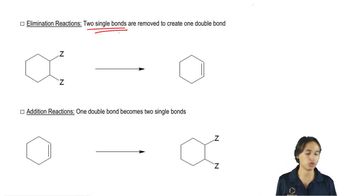
Elimination reactions involve the removal of atoms or groups from a molecule, resulting in the formation of a double bond or a ring structure. In this context, the reaction with HCl suggests that a proton (H+) is likely being added to one part of the molecule while a leaving group departs, leading to the formation of a more stable product. Understanding the mechanism of elimination is crucial for predicting the outcome of the reaction.
Recommended video:
Guided course
00:40
Recognizing Elimination Reactions.

Mechanism of Electrophilic Aromatic Substitution

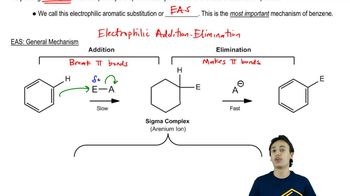
Electrophilic aromatic substitution (EAS) is a fundamental reaction in organic chemistry where an electrophile replaces a hydrogen atom on an aromatic ring. In this case, HCl can act as an electrophile, and the presence of electron-donating groups, like methoxy (–OCH3), can influence the reactivity and orientation of the substitution. Recognizing how substituents affect the mechanism is essential for proposing accurate reaction pathways.
Recommended video:
Guided course
06:52
EAS General Mechanism

Resonance and Stability

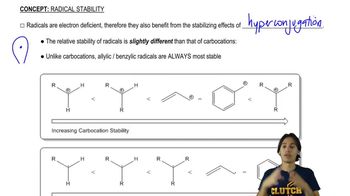
Resonance refers to the delocalization of electrons in a molecule, which can stabilize certain structures. In the context of the provided reaction, the stability of the intermediates formed during the elimination process can significantly affect the reaction pathway. Understanding how resonance contributes to the stability of intermediates helps in predicting the favored products of the reaction.
Recommended video:
Guided course
03:43
The radical stability trend.
Related Practice