Ch. 18 - Reactions of Benzene and Substituted Benzenes
Bruice - Organic Chemistry 8th Edition
Bruice8th EditionOrganic ChemistryISBN: 9780135213711Not the one you use?Change textbook
Chapter 19, Problem 42d,e,f

Draw the structure for each of the following:
d. benzaldehyde
e. anisole
f. styrene

Verified step by step guidance
1
Step 1: Understand the structure of benzaldehyde. Benzaldehyde is an aromatic aldehyde. It consists of a benzene ring (C₆H₆) with a formyl group (-CHO) attached to one of the carbons in the ring. Draw a benzene ring and attach the -CHO group to one of the carbons.
Step 2: Understand the structure of anisole. Anisole is an aromatic ether. It consists of a benzene ring (C₆H₆) with a methoxy group (-OCH₃) attached to one of the carbons in the ring. Draw a benzene ring and attach the -OCH₃ group to one of the carbons.
Step 3: Understand the structure of styrene. Styrene is an aromatic compound with a vinyl group (-CH=CH₂) attached to a benzene ring. Draw a benzene ring and attach the -CH=CH₂ group to one of the carbons.
Step 4: Ensure that the structures are drawn with correct bond angles and connectivity. For benzaldehyde, the -CHO group should be single-bonded to the benzene ring and double-bonded to oxygen. For anisole, the -OCH₃ group should be single-bonded to the benzene ring. For styrene, the -CH=CH₂ group should be single-bonded to the benzene ring and contain a double bond between the two carbons in the vinyl group.
Step 5: Verify that all atoms in the structures satisfy the octet rule (where applicable) and that the structures are consistent with the IUPAC names provided. Double-check the placement of functional groups and the aromaticity of the benzene ring in each compound.

Verified video answer for a similar problem:

This video solution was recommended by our tutors as helpful for the problem above.
Video duration:
1m
Was this helpful?

Key Concepts

Here are the essential concepts you must grasp in order to answer the question correctly.

Functional Groups

Functional groups are specific groups of atoms within molecules that are responsible for the characteristic chemical reactions of those molecules. In organic chemistry, recognizing functional groups such as aldehydes in benzaldehyde, ethers in anisole, and alkenes in styrene is crucial for understanding their reactivity and properties.
Recommended video:
Guided course
02:36
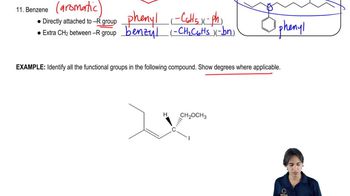
Identifying Functional Groups

Structural Representation

Structural representation refers to the way in which the arrangement of atoms in a molecule is depicted. This can include Lewis structures, condensed formulas, or skeletal structures. Accurately drawing these structures is essential for visualizing molecular geometry and predicting chemical behavior.
Recommended video:
Guided course
05:09
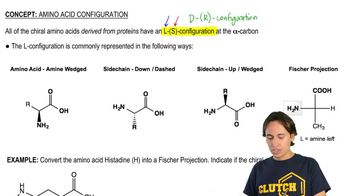
Representations of L-Configuration

Aromatic Compounds

Aromatic compounds are a class of cyclic compounds that exhibit resonance and stability due to their delocalized π-electron systems. Benzaldehyde and anisole are examples of aromatic compounds, which influence their chemical properties and reactions, making it important to understand their structure and stability.
Recommended video:
Guided course
08:19
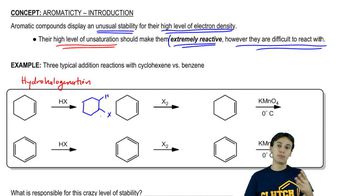
Intro to Aromaticity