Ch. 18 - Reactions of Benzene and Substituted Benzenes
Bruice - Organic Chemistry 8th Edition
Bruice8th EditionOrganic ChemistryISBN: 9780135213711Not the one you use?Change textbook
Chapter 19, Problem 41e

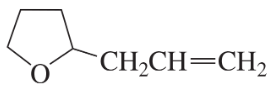
Design a synthesis for each of the following, using an intramolecular reaction:
e.

Verified step by step guidance
1
Step 1: Analyze the target molecule. The structure contains a tetrahydrofuran (THF) ring fused with a side chain containing an allyl group (CH2CH=CH2). This suggests the use of an intramolecular reaction to form the THF ring.
Step 2: Identify the precursor. To form the THF ring via an intramolecular reaction, the precursor should contain a hydroxyl group (-OH) and a leaving group (e.g., halide or tosylate) on the same molecule, positioned appropriately for cyclization.
Step 3: Propose the starting material. A suitable starting material could be 4-hydroxybutyl allyl ether (HOCH2CH2CH2CH2OCH2CH=CH2), which contains both the hydroxyl group and the allyl ether functional group.
Step 4: Suggest the reaction conditions. Use an acid catalyst (e.g., H2SO4 or HCl) to protonate the hydroxyl group, facilitating intramolecular nucleophilic attack on the allyl ether carbon, leading to ring closure and formation of the THF ring.
Step 5: Verify the mechanism. The reaction proceeds via an intramolecular SN2 mechanism, where the hydroxyl group attacks the electrophilic carbon of the allyl ether, displacing the leaving group and forming the THF ring.

Verified video answer for a similar problem:

This video solution was recommended by our tutors as helpful for the problem above.
Video duration:
7m
Was this helpful?

Key Concepts

Here are the essential concepts you must grasp in order to answer the question correctly.

Intramolecular Reactions

Intramolecular reactions occur when a reaction takes place within a single molecule, leading to the formation of a new bond. This often involves the molecule folding or bending to bring reactive groups into proximity, facilitating the reaction. Understanding these reactions is crucial for designing syntheses, as they can lead to the formation of cyclic compounds or other complex structures efficiently.
Recommended video:
2:29
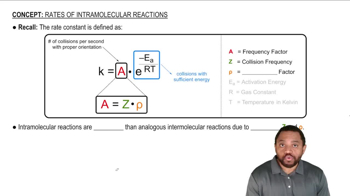
Rates of Intramolecular Reactions Concept 1

Functional Groups

Functional groups are specific groups of atoms within molecules that are responsible for the characteristic chemical reactions of those molecules. In the provided structure, the presence of an alkene (C=C) and an ether (C-O) functional group is significant. Recognizing these groups helps in predicting reactivity and the types of reactions that can occur during synthesis.
Recommended video:
Guided course
02:36
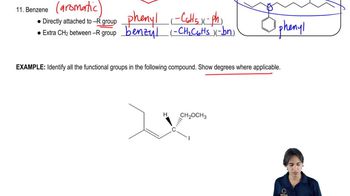
Identifying Functional Groups

Synthesis Design

Synthesis design in organic chemistry involves planning a series of chemical reactions to construct a desired compound from simpler starting materials. This requires knowledge of reaction mechanisms, functional group transformations, and the ability to visualize molecular interactions. Effective synthesis design often utilizes intramolecular reactions to enhance efficiency and yield in the production of complex molecules.
Recommended video:
1:16
Synthesis of Amino Acids: Strecker Synthesis Example 1