Ch. 18 - Reactions of Benzene and Substituted Benzenes
Bruice - Organic Chemistry 8th Edition
Bruice8th EditionOrganic ChemistryISBN: 9780135213711Not the one you use?Change textbook
Chapter 19, Problem 83

Describe two synthetic routes for the preparation of p-methoxyaniline from benzene.

Verified step by step guidance
1
Step 1: **First Synthetic Route (via Nitration and Reduction)** - Begin with benzene as the starting material. Perform a nitration reaction by treating benzene with a mixture of concentrated HNO₃ (nitric acid) and concentrated H₂SO₄ (sulfuric acid). This introduces a nitro group (-NO₂) at the para position of benzene, forming nitrobenzene.
Step 2: Reduce the nitro group (-NO₂) in nitrobenzene to an amino group (-NH₂) to form aniline. This can be achieved using a reducing agent such as Sn/HCl (tin and hydrochloric acid) or Fe/HCl (iron and hydrochloric acid), followed by neutralization with a base.
Step 3: Perform a methylation reaction to introduce the methoxy group (-OCH₃) at the para position of aniline. This can be done by reacting aniline with dimethyl sulfate (CH₃O)₂SO₂ or methyl iodide (CH₃I) in the presence of a base like NaOH or K₂CO₃.
Step 4: **Second Synthetic Route (via Friedel-Crafts Alkylation and Amination)** - Start with benzene and perform a Friedel-Crafts alkylation using methyl chloride (CH₃Cl) and AlCl₃ (aluminum chloride) as a catalyst. This introduces a methyl group (-CH₃) to form toluene.
Step 5: Oxidize the methyl group (-CH₃) in toluene to a carboxylic acid (-COOH) using a strong oxidizing agent like KMnO₄ (potassium permanganate). Then, convert the carboxylic acid to an amine (-NH₂) via amide formation followed by reduction. Finally, introduce the methoxy group (-OCH₃) at the para position using a methylation reaction as described in Step 3.

Verified video answer for a similar problem:

This video solution was recommended by our tutors as helpful for the problem above.
Video duration:
4m
Was this helpful?

Key Concepts

Here are the essential concepts you must grasp in order to answer the question correctly.

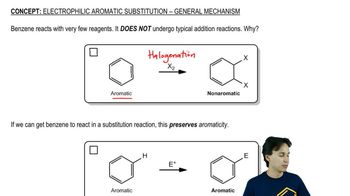
Electrophilic Aromatic Substitution (EAS)

Electrophilic Aromatic Substitution is a fundamental reaction in organic chemistry where an electrophile replaces a hydrogen atom on an aromatic ring. In the synthesis of p-methoxyaniline, benzene undergoes EAS to introduce a methoxy group (-OCH3) and subsequently an amino group (-NH2) at the para position, facilitated by the presence of activating groups that enhance the reactivity of the aromatic system.
Recommended video:

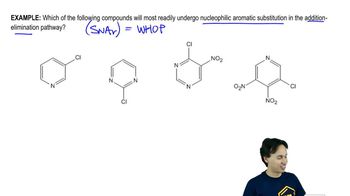
Nucleophilic Aromatic Substitution (NAS)

Nucleophilic Aromatic Substitution is a reaction where a nucleophile attacks an aromatic ring, typically at a position that is activated by electron-withdrawing groups. In the context of synthesizing p-methoxyaniline, this method can be employed after introducing a suitable leaving group on the benzene ring, allowing the nucleophile (an amine) to replace the leaving group and form the desired product.
Recommended video:
Guided course
02:10
NAS in the addition-elimination pathway

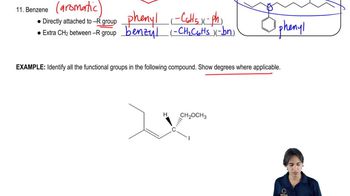
Functional Group Interconversion

Functional Group Interconversion refers to the transformation of one functional group into another within a molecule. In the preparation of p-methoxyaniline, this concept is crucial as it allows for the conversion of the methoxy group into an amino group through various chemical reactions, such as reduction or substitution, thereby facilitating the overall synthetic route from benzene to the target compound.
Recommended video:
Guided course
02:36
Identifying Functional Groups