Ch. 18 - Reactions of Benzene and Substituted Benzenes
Bruice - Organic Chemistry 8th Edition
Bruice8th EditionOrganic ChemistryISBN: 9780135213711Not the one you use?Change textbook
Chapter 19, Problem 81

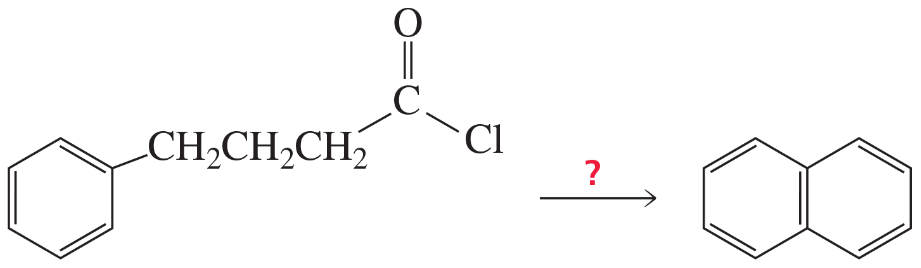
Describe how naphthalene can be prepared from the given starting material.

Verified step by step guidance
1
Step 1: Analyze the starting material. The given compound is phenylpropionyl chloride, which contains a benzene ring attached to a three-carbon chain ending in an acyl chloride functional group (C=O-Cl). This structure suggests that the reaction will involve cyclization and aromatic stabilization.
Step 2: Recognize the target molecule. Naphthalene is a polycyclic aromatic hydrocarbon consisting of two fused benzene rings. The synthesis will require forming a second aromatic ring through cyclization and elimination reactions.
Step 3: Propose the reaction mechanism. The synthesis of naphthalene from phenylpropionyl chloride typically involves a Friedel-Crafts acylation reaction followed by cyclization. A Lewis acid catalyst, such as AlCl₃, is used to activate the acyl chloride group, facilitating the formation of an electrophilic intermediate.
Step 4: Describe the cyclization process. After the acylation step, the intermediate undergoes intramolecular cyclization. This step involves the formation of a new carbon-carbon bond between the benzene ring and the terminal carbon of the three-carbon chain, leading to the formation of a second aromatic ring.
Step 5: Finalize the reaction. The cyclized intermediate undergoes dehydrogenation to form naphthalene. This step ensures the aromaticity of both rings in the final product. Common reagents for dehydrogenation include Pd/C or other catalysts under high-temperature conditions.

Verified video answer for a similar problem:

This video solution was recommended by our tutors as helpful for the problem above.
Video duration:
6m
Was this helpful?

Key Concepts

Here are the essential concepts you must grasp in order to answer the question correctly.

Naphthalene Structure and Properties

Naphthalene is a polycyclic aromatic hydrocarbon consisting of two fused benzene rings. Its structure contributes to its stability and unique properties, such as its volatility and ability to undergo electrophilic substitution reactions. Understanding its molecular structure is essential for predicting its reactivity and the types of reactions that can be used to synthesize it.
Recommended video:
1:19
Polymers Structure and Properties Concept 1

Electrophilic Aromatic Substitution (EAS)

Electrophilic aromatic substitution is a fundamental reaction mechanism in organic chemistry where an electrophile replaces a hydrogen atom on an aromatic ring. This process is crucial for synthesizing compounds like naphthalene from simpler aromatic precursors. Familiarity with EAS helps in understanding how to manipulate starting materials to achieve desired products.
Recommended video:

Synthetic Pathways for Naphthalene

There are several synthetic pathways to prepare naphthalene, including the fusion of two benzene rings or the cyclization of certain precursors. Common methods include the reduction of 1,4-dihalobenzenes or the dehydrogenation of alkylnaphthalenes. Knowing these pathways allows chemists to choose the most efficient route based on the available starting materials.
Recommended video:
2:13
Energy Production In Biochemical Pathways Concept 1