Ch. 17 - Reactions at the Alpha-Carbon
Bruice - Organic Chemistry 8th Edition
Bruice8th EditionOrganic ChemistryISBN: 9780135213711Not the one you use?Change textbook
Chapter 18, Problem 75b

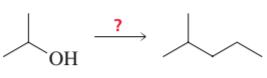
Show how the following compounds can be synthesized. The only carbon-containing compounds available to you for each synthesis are shown.
b. Synthesis pathway showing a hydroxyl group and an unknown compound transforming into a branched carbon structure.

Verified step by step guidance
1
Identify the target compound and analyze its functional groups, carbon skeleton, and connectivity. This will help determine the synthetic strategy and retrosynthetic steps.
Perform a retrosynthetic analysis by breaking down the target compound into simpler precursors. Consider disconnections that lead to the starting materials provided in the problem.
Determine the reagents and reaction conditions required to form the target compound from the precursors. Use known organic reactions such as substitution, elimination, addition, or rearrangement reactions.
Plan the forward synthesis by writing out the sequence of reactions step by step, ensuring that each step is chemically feasible and leads to the desired intermediate or final product.
Verify the synthesis by checking that the starting materials, reagents, and reaction conditions align with the problem constraints and that the target compound is formed as the final product.

Verified video answer for a similar problem:

This video solution was recommended by our tutors as helpful for the problem above.
Was this helpful?

Key Concepts

Here are the essential concepts you must grasp in order to answer the question correctly.

Synthetic Pathways

Synthetic pathways refer to the series of chemical reactions and transformations that convert starting materials into desired products. Understanding these pathways is crucial for planning the synthesis of organic compounds, as it involves selecting appropriate reagents and conditions to achieve the desired molecular structure.
Recommended video:
2:13
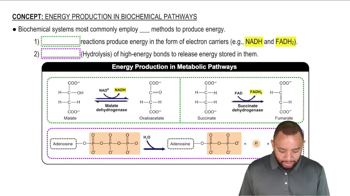
Energy Production In Biochemical Pathways Concept 1

Functional Groups

Functional groups are specific groups of atoms within molecules that are responsible for the characteristic chemical reactions of those molecules. Recognizing functional groups in the compounds involved in the synthesis helps predict reactivity and selectivity during chemical reactions, guiding the synthesis process effectively.
Recommended video:
Guided course
02:36
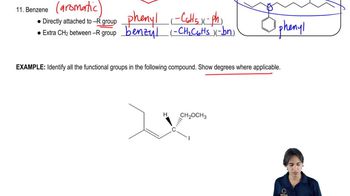
Identifying Functional Groups

Reagents and Reaction Conditions

Reagents are substances used to bring about a chemical reaction, while reaction conditions include temperature, pressure, and solvent choice. Understanding the role of different reagents and the optimal conditions for reactions is essential for successful synthesis, as these factors can significantly influence the yield and purity of the final product.
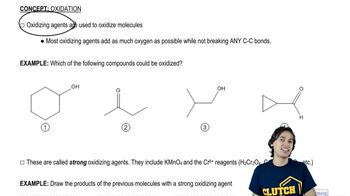
Recommended video: