
The following reaction is known as the benzoin condensation. The reaction does not take place if sodium hydroxide is used instead of sodium cyanide. Propose a mechanism for the reaction and explain why the reaction does not occur if hydroxide ion is the base.
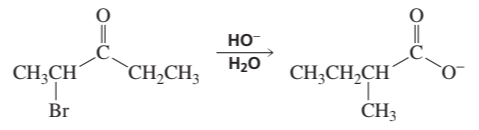
A carboxylic acid is formed when an a-haloketone reacts with hydroxide ion. This reaction is called a Favorskii reaction. Propose a mechanism for the following Favorskii reaction. (Hint: In the first step, HO- removes a proton from the a-carbon that is not bonded to Br; a three-membered ring is formed in the second step; and HO- is a nucleophile in the third step.)

Verified step by step guidance
Verified video answer for a similar problem:
Key Concepts
Favorskii Reaction
Nucleophilic Attack
Three-Membered Ring Formation
Show how the following compounds can be synthesized. The only carbon-containing compounds available to you for each synthesis are shown.
b.
Propose a mechanism for each of the following reactions:
b.
A Mannich reaction puts a -group on the α-carbon of a ketone. Propose a mechanism for the reaction.
A Cannizzaro reaction is the reaction of an aldehyde that has no a-hydrogens with concentrated aqueous sodium hydroxide. In this reaction, half the aldehyde is converted to a carboxylic acid and the other half is converted to an alcohol. Propose a mechanism for the following Cannizzaro reaction:
A student tried to prepare the following compounds using aldol condensations. Which of these compounds was she successful in synthesizing? Explain why the other syntheses were not successful.
