Ch. 17 - Reactions at the Alpha-Carbon
Bruice - Organic Chemistry 8th Edition
Bruice8th EditionOrganic ChemistryISBN: 9780135213711Not the one you use?Change textbook
Chapter 18, Problem 2a

Give an example for each of the following:
a. a β-keto nitrile

Verified step by step guidance
1
Step 1: Understand the term 'β-keto nitrile'. A β-keto nitrile is a compound that contains both a ketone functional group (C=O) and a nitrile functional group (-C≡N), where the nitrile group is located at the β-position relative to the ketone. This means there is one carbon atom between the ketone and the nitrile group.
Step 2: Identify the general structure of a β-keto nitrile. The structure can be represented as R-CO-CH₂-C≡N, where R is an alkyl or aryl group attached to the ketone.
Step 3: Choose a specific example of a β-keto nitrile. For instance, you can use ethyl as the R group to form ethyl β-keto nitrile. Its structure would be CH₃-CO-CH₂-C≡N.
Step 4: Verify the structure to ensure it meets the criteria. Confirm that the ketone group (C=O) and the nitrile group (-C≡N) are separated by exactly one carbon atom.
Step 5: Note that β-keto nitriles are important intermediates in organic synthesis, often used in reactions such as the Michael addition or in the synthesis of heterocyclic compounds.

Verified video answer for a similar problem:

This video solution was recommended by our tutors as helpful for the problem above.
Video duration:
3m
Was this helpful?

Key Concepts

Here are the essential concepts you must grasp in order to answer the question correctly.

b-keto nitrile

A b-keto nitrile is a compound that contains both a ketone functional group and a nitrile group. The 'b' indicates that the nitrile group is located on the beta carbon relative to the carbonyl carbon of the ketone. This structure is significant in organic synthesis, as it can participate in various reactions, including nucleophilic additions and cyclization processes.
Recommended video:
Guided course
01:01
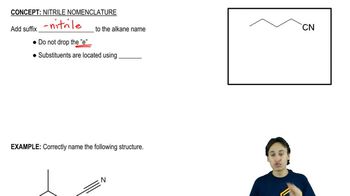
Nitrile Nomenclature

functional groups

Functional groups are specific groups of atoms within molecules that are responsible for the characteristic chemical reactions of those molecules. In the case of b-keto nitriles, the ketone (C=O) and nitrile (C≡N) groups dictate the reactivity and properties of the compound. Understanding functional groups is essential for predicting how a compound will behave in chemical reactions.
Recommended video:
Guided course
02:36
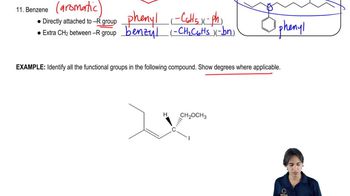
Identifying Functional Groups

nucleophilic addition reactions

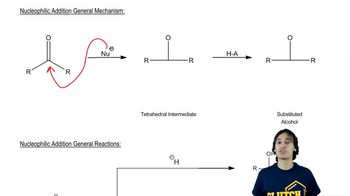
Nucleophilic addition reactions occur when a nucleophile attacks an electrophilic carbon atom, leading to the formation of new bonds. In b-keto nitriles, the carbonyl carbon is electrophilic, making it susceptible to attack by nucleophiles. This type of reaction is crucial in organic chemistry for constructing complex molecules and modifying existing ones.
Recommended video:
Guided course
08:27
Nucleophilic Addition