
The following reaction is known as the benzoin condensation. The reaction does not take place if sodium hydroxide is used instead of sodium cyanide. Propose a mechanism for the reaction and explain why the reaction does not occur if hydroxide ion is the base.
Ch. 17 - Reactions at the Alpha-Carbon
Chapter 18, Problem 90
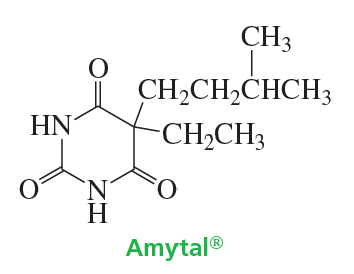
Amobarbital is a sedative marketed under the trade name Amytal. Propose a synthesis of amobarbital, using diethyl malonate and urea as two of the starting materials.

Verified step by step guidance1
Step 1: Begin with diethyl malonate as the starting material. Perform a base-catalyzed alkylation reaction using ethyl bromide to introduce the ethyl group at the alpha-carbon of diethyl malonate. This step involves deprotonation of the alpha-carbon followed by nucleophilic substitution.
Step 2: Hydrolyze the diethyl malonate derivative under acidic or basic conditions to convert the ester groups into carboxylic acids. This step yields a malonic acid derivative with the ethyl group attached.
Step 3: Decarboxylate the malonic acid derivative by heating it. This removes one of the carboxylic acid groups, leaving behind a mono-carboxylic acid with the ethyl group attached.
Step 4: React the resulting mono-carboxylic acid with urea under acidic or basic conditions to form the barbituric acid core. This step involves a condensation reaction where urea contributes the nitrogen atoms to the cyclic structure.
Step 5: Perform a second alkylation reaction on the barbituric acid core using allyl bromide to introduce the allyl group at the nitrogen atom. This final step completes the synthesis of amobarbital.

Verified video answer for a similar problem:
This video solution was recommended by our tutors as helpful for the problem above.
Video duration:
2mWas this helpful?
Key Concepts
Here are the essential concepts you must grasp in order to answer the question correctly.
Diethyl Malonate
Diethyl malonate is a versatile compound used in organic synthesis, particularly in the malonic ester synthesis. It contains two ester functional groups and is often employed as a nucleophile in alkylation reactions. Its ability to form enolates makes it a key intermediate in the synthesis of various compounds, including barbiturates like amobarbital.
Recommended video:
Guided course
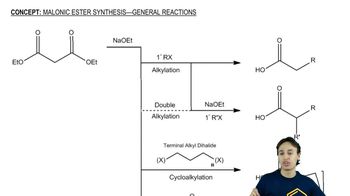
General Reactions
Urea
Urea is a simple organic compound with the formula CO(NH2)2, and it serves as a key building block in the synthesis of many nitrogen-containing compounds. In the context of barbiturate synthesis, urea reacts with malonic esters to form barbituric acid, which can be further modified to produce sedatives like amobarbital. Its reactivity is crucial for forming the necessary carbon-nitrogen bonds.
Recommended video:
Peptide Sequencing: Edman Degradation Concept 1
Barbiturate Synthesis
Barbiturate synthesis involves the formation of a barbituric acid derivative through the condensation of urea and diethyl malonate. This process typically includes cyclization and subsequent modifications to yield various barbiturates, which are central nervous system depressants. Understanding the reaction mechanisms and functional group transformations is essential for proposing effective synthetic routes for compounds like amobarbital.
Recommended video:
Synthesis of Amino Acids: Strecker Synthesis Example 1
Related Practice
Textbook Question
1
views
Textbook Question
A compound known as Hagemann's ester can be prepared by treating a mixture of formaldehyde and ethyl acetoacetate first with base and then with acid and heat. Write the structure for the product of each of the steps.
b. The second step is a Michael addition.
1
views
Textbook Question
Alkylation of the following compound with methyl iodide under two different conditions forms two different ketoesters (A and B). Each ketoester forms a cyclic diketone (C and D) when treated with methoxide ion in methanol. a. Draw the structures of A and B, and indicate the conditions used in the alkylation reaction that cause that ketoester to be formed.
1
views
