
Textbook Question
Draw the products of the following reactions:
d. diethyl 1,2-benzenedicarboxylate + sodium ethoxide: (1) slow addition of ethyl acetate; (2) HCl
4
views

 Verified step by step guidance
 02:26
02:26
 09:51
09:51 03:06
03:06Draw the products of the following reactions:
d. diethyl 1,2-benzenedicarboxylate + sodium ethoxide: (1) slow addition of ethyl acetate; (2) HCl
An aldol addition can be catalyzed by acids as well as by bases. Propose a mechanism for the acid-catalyzed aldol addition of propanal.
Draw the products of the following reactions:
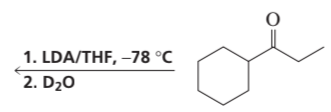
b.
Which of the following compounds decarboxylates when heated?
In the presence of excess base and excess halogen, a methyl ketone is converted to a carboxylate ion. The reaction is known as the haloform reaction because one of the products is haloform (chloroform, bromoform, or iodoform). Before spectroscopy became a routine analytical tool, the haloform reaction served as a test for methyl ketones: the formation of iodoform, a bright yellow compound, signaled that a methyl ketone was present. Why do only methyl ketones form a haloform?
The 1H NMR chemical shifts of nitromethane, dinitromethane, and trinitromethane are at δ6.10, δ4.33, and δ7.52. Match each chemical shift with the compound. Explain how chemical shift correlates with pKa.