Ch. 16 - Reactions of Aldehydes and Ketones • More Reactions of Carboxylic Acid Derivatives
Bruice - Organic Chemistry 8th Edition
Bruice8th EditionOrganic ChemistryISBN: 9780135213711Not the one you use?Change textbook
Chapter 17, Problem 39(1)

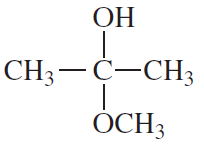
Which of the following are a. hemiacetals? b. acetals? c. hydrates?
1. Structural formula of a compound showing a central carbon atom bonded to an OH group, a methyl group, and an ether group.

Verified step by step guidance
1
Step 1: Identify the functional groups present in the given structure. The molecule contains a hydroxyl group (-OH) and a methoxy group (-OCH3) attached to the same carbon atom.
Step 2: Recall the definitions of hemiacetals, acetals, and hydrates. A hemiacetal contains one hydroxyl group (-OH) and one alkoxy group (-OR) attached to the same carbon atom. An acetal contains two alkoxy groups (-OR) attached to the same carbon atom. A hydrate contains two hydroxyl groups (-OH) attached to the same carbon atom.
Step 3: Compare the structure to the definitions. The presence of one hydroxyl group (-OH) and one alkoxy group (-OCH3) attached to the same carbon atom matches the definition of a hemiacetal.
Step 4: Confirm that the molecule does not fit the definitions of an acetal or a hydrate. The molecule does not have two alkoxy groups (-OR) or two hydroxyl groups (-OH) attached to the same carbon atom, so it is not an acetal or a hydrate.
Step 5: Conclude that the given structure is a hemiacetal based on the functional groups present and the definitions provided.

Verified video answer for a similar problem:

This video solution was recommended by our tutors as helpful for the problem above.
Video duration:
3m
Was this helpful?

Key Concepts

Here are the essential concepts you must grasp in order to answer the question correctly.

Hemiacetals

Hemiacetals are formed when an aldehyde or ketone reacts with an alcohol, resulting in a compound that contains both a hydroxyl group (-OH) and an ether group (-O-alkyl). They are characterized by having one -OH group and one -O-alkyl group attached to the same carbon atom, which is typically derived from the carbonyl carbon of the aldehyde or ketone.
Recommended video:
Guided course
06:23
Monosaccharides - Forming Cyclic Hemiacetals

Acetals

Acetals are derived from hemiacetals through a reaction with an additional alcohol molecule, leading to the replacement of the hydroxyl group with another alkoxy group (-O-alkyl). Acetals are stable compounds that contain two -O-alkyl groups attached to the same carbon atom, which is no longer reactive as a carbonyl carbon, making them less susceptible to hydrolysis compared to hemiacetals.
Recommended video:
Guided course
04:29
Acetal Protecting Group

Hydrates

Hydrates are formed when water adds to a carbonyl compound, such as an aldehyde or ketone, resulting in a molecule that contains two hydroxyl groups (-OH) attached to the same carbon atom. This process is a type of hydration reaction and is characterized by the presence of a carbon atom bonded to two -OH groups, distinguishing it from hemiacetals and acetals.
Recommended video:
Guided course
09:11
Alkyne Hydration