Ch. 16 - Reactions of Aldehydes and Ketones • More Reactions of Carboxylic Acid Derivatives
Bruice - Organic Chemistry 8th Edition
Bruice8th EditionOrganic ChemistryISBN: 9780135213711Not the one you use?Change textbook
Chapter 17, Problem 42b

What reagent could you use to reduce only the keto group?
<IMAGE>

Verified step by step guidance
1
Step 1: Analyze the structure of the molecule before and after the reaction. The starting molecule contains a keto group (C=O) and an ester group (COOCH₃). After the reaction, the keto group is reduced to an alcohol (OH), while the ester group remains unchanged.
Step 2: Understand the selectivity required. The reagent must selectively reduce the keto group without affecting the ester group. This requires a mild reducing agent that targets ketones specifically.
Step 3: Recall suitable reagents for selective reduction of ketones. Sodium borohydride (NaBH₄) is a common reducing agent that selectively reduces ketones to alcohols without reacting with esters under standard conditions.
Step 4: Consider the reaction conditions. Sodium borohydride typically works in protic solvents like ethanol or methanol, which help facilitate the reduction of the keto group.
Step 5: Confirm the reagent choice. Sodium borohydride is appropriate for this reaction because it selectively reduces the keto group to an alcohol while leaving the ester group intact.

Verified video answer for a similar problem:

This video solution was recommended by our tutors as helpful for the problem above.
Video duration:
4m
Was this helpful?

Key Concepts

Here are the essential concepts you must grasp in order to answer the question correctly.

Keto Group

A keto group is a functional group characterized by a carbonyl (C=O) bonded to two other carbon atoms. It is commonly found in ketones, which are organic compounds with the general formula R2C=O. Understanding the structure and reactivity of keto groups is essential for predicting how they will behave in chemical reactions, particularly in reduction processes.
Recommended video:
Guided course
04:42
Sequence Groups

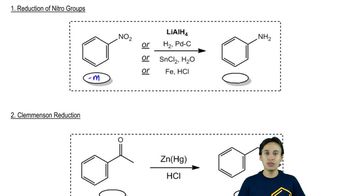
Reduction Reagents

Reduction reagents are substances that donate electrons to another compound, resulting in a decrease in oxidation state. Common reagents for reducing keto groups include sodium borohydride (NaBH4) and lithium aluminum hydride (LiAlH4). The choice of reagent is crucial, as some may reduce multiple functional groups, while others are selective for ketones.
Recommended video:
Guided course
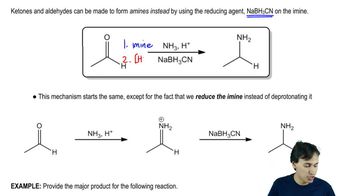
07:12
Reductive Amination

Selectivity in Organic Reactions

Selectivity refers to the ability of a reagent to react with a specific functional group in the presence of others. In the context of reducing a keto group, selectivity is important to ensure that only the desired functional group is reduced without affecting other groups, such as alcohols or aldehydes. Understanding the principles of selectivity helps chemists design reactions that yield the desired products efficiently.
Recommended video:
Guided course
02:17
Identifying organic molecules