
Ch. 16 - Reactions of Aldehydes and Ketones • More Reactions of Carboxylic Acid Derivatives
Bruice - Organic Chemistry 8th Edition
Bruice8th EditionOrganic ChemistryISBN: 9780135213711Not the one you use?Change textbook
Chapter 17, Problem 91

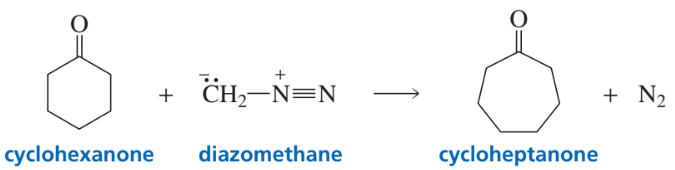
When a cyclic ketone reacts with diazomethane, the next larger cyclic ketone is formed. This is called a ring-expansion reaction. Draw a mechanism for the following ring-expansion reaction.
Cyclic ketone reacts with diazomethane to form a larger cyclic ketone, illustrating a ring-expansion reaction mechanism.

Verified step by step guidance
1
Step 1: Begin by identifying the cyclic ketone and diazomethane as the reactants. Diazomethane (CH₂N₂) is a highly reactive compound that serves as a source of a carbene (a neutral species with a divalent carbon atom). The reaction starts with the nucleophilic attack of the lone pair on the oxygen atom of the ketone on the electrophilic carbon of diazomethane.
Step 2: The nucleophilic attack forms a new bond between the oxygen of the ketone and the carbon of diazomethane. This intermediate is a zwitterion, where the oxygen carries a positive charge and the nitrogen of diazomethane carries a negative charge. This step sets up the system for the next rearrangement.
Step 3: The next step involves the migration of one of the carbon-carbon bonds adjacent to the ketone carbonyl group. This migration is facilitated by the formation of a carbene intermediate. The bond migration expands the ring by one carbon atom, creating a new cyclic structure.
Step 4: The rearrangement results in the formation of a new cyclic ketone with one additional carbon in the ring. The nitrogen from diazomethane is released as molecular nitrogen (N₂), which is a very stable byproduct and drives the reaction forward.
Step 5: Finally, confirm the structure of the product. The new cyclic ketone should have one more carbon in the ring compared to the starting material. Verify that the mechanism is consistent with the principles of organic chemistry, including charge balance and proper electron flow.

Verified video answer for a similar problem:

This video solution was recommended by our tutors as helpful for the problem above.
Video duration:
4m
Was this helpful?

Key Concepts

Here are the essential concepts you must grasp in order to answer the question correctly.

Cyclic Ketones

Cyclic ketones are organic compounds that contain a carbonyl group (C=O) within a ring structure. The presence of the carbonyl group influences the reactivity of the molecule, making it susceptible to various reactions, including ring-expansion. Understanding the structure and properties of cyclic ketones is essential for predicting their behavior in chemical reactions.
Recommended video:
Guided course
02:27
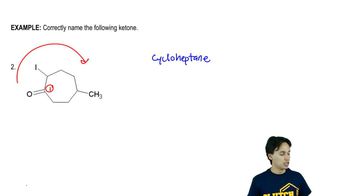
Name the ketone

Ring-Expansion Reaction

A ring-expansion reaction involves the transformation of a smaller cyclic compound into a larger cyclic compound, typically through the addition of new atoms or groups. In the case of cyclic ketones reacting with diazomethane, the reaction leads to the formation of a larger cyclic ketone. This process is significant in organic synthesis as it allows for the construction of more complex molecular architectures.
Recommended video:
Guided course
05:14
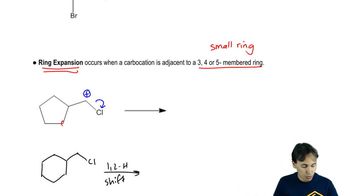
Ring Expansion

Mechanism of Reaction

The mechanism of a reaction describes the step-by-step sequence of elementary reactions that occur during the transformation of reactants into products. For the ring-expansion reaction involving cyclic ketones and diazomethane, understanding the mechanism is crucial for illustrating how bonds are broken and formed, and how intermediates are generated. This knowledge helps in predicting the outcome of the reaction and designing synthetic pathways.
Recommended video:
Guided course
02:16
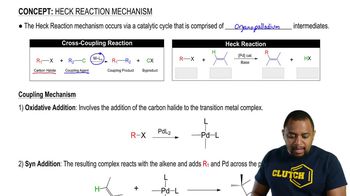
Heck Reaction Mechanism