
Ch. 16 - Reactions of Aldehydes and Ketones • More Reactions of Carboxylic Acid Derivatives
Bruice - Organic Chemistry 8th Edition
Bruice8th EditionOrganic ChemistryISBN: 9780135213711Not the one you use?Change textbook
Chapter 17, Problem 96

The Baylis-Hillman reaction is a DABCO (1,4-diazabicyclo[2.2.2]octane) catalyzed reaction of an α,β-unsaturated carbonyl compound with an aldehyde to form an allylic alcohol. Propose a mechanism for the reaction. (Hint: DABCO serves as both a nucleophile and as a base in the reaction.)

Verified step by step guidance
1
Step 1: Initiation - DABCO acts as a nucleophile and attacks the β-carbon of the α,β-unsaturated carbonyl compound, forming a zwitterionic intermediate. This step is crucial as it activates the α,β-unsaturated carbonyl compound for further reaction.
Step 2: Aldehyde Addition - The zwitterionic intermediate formed in Step 1 reacts with the aldehyde. The nucleophilic carbon in the zwitterionic intermediate attacks the electrophilic carbonyl carbon of the aldehyde, forming a new carbon-carbon bond and generating a second intermediate.
Step 3: Proton Transfer - A proton transfer occurs to stabilize the intermediate formed in Step 2. DABCO, acting as a base, facilitates this proton transfer, leading to the formation of a stabilized intermediate with an alcohol group.
Step 4: Regeneration of DABCO - The intermediate undergoes elimination of DABCO, regenerating the catalyst and forming the final allylic alcohol product. This step ensures that DABCO is available for further catalytic cycles.
Step 5: Final Product Formation - The reaction concludes with the formation of the allylic alcohol as the final product, which is characterized by the presence of a hydroxyl group attached to an allylic carbon.

Verified video answer for a similar problem:

This video solution was recommended by our tutors as helpful for the problem above.
Video duration:
6m
Was this helpful?

Key Concepts

Here are the essential concepts you must grasp in order to answer the question correctly.

Baylis-Hillman Reaction

The Baylis-Hillman reaction is a carbon-carbon bond-forming reaction that involves the addition of an aldehyde to an α,β-unsaturated carbonyl compound, resulting in the formation of an allylic alcohol. This reaction is notable for its ability to create complex molecules with high stereochemical control and is widely used in organic synthesis.
Recommended video:
Guided course
05:09
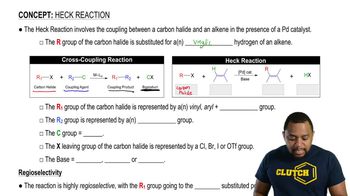
Heck Reaction

Role of DABCO

DABCO (1,4-diazabicyclo[2.2.2]octane) acts as a bifunctional catalyst in the Baylis-Hillman reaction, serving both as a nucleophile and a base. As a nucleophile, it can attack the electrophilic carbon of the α,β-unsaturated carbonyl compound, while its basicity helps deprotonate the aldehyde, facilitating the formation of the desired product.
Recommended video:
1:10
Coenzyme A Example 5

Mechanism of the Reaction

The mechanism of the Baylis-Hillman reaction involves several key steps: nucleophilic attack of DABCO on the carbonyl carbon of the aldehyde, followed by the addition of the resulting intermediate to the α,β-unsaturated carbonyl compound. This is followed by proton transfer and elimination steps that yield the final allylic alcohol product, showcasing the interplay of nucleophilic and basic properties of DABCO.
Recommended video:
Guided course
02:16
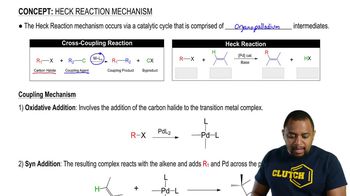
Heck Reaction Mechanism