Ch. 16 - Reactions of Aldehydes and Ketones • More Reactions of Carboxylic Acid Derivatives
Bruice - Organic Chemistry 8th Edition
Bruice8th EditionOrganic ChemistryISBN: 9780135213711Not the one you use?Change textbook
Chapter 17, Problem 54h

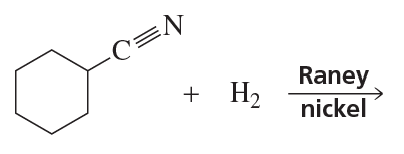
What are the products of the following reactions?
h. Chemical reaction diagram showing an alkyne and hydrogen with Raney nickel catalyst for amine reduction.

Verified step by step guidance
1
Step 1: Identify the functional group in the reactant. The reactant contains a nitrile group (-C≡N), which is a carbon triple-bonded to a nitrogen atom.
Step 2: Recognize the reaction conditions. The presence of hydrogen gas (H₂) and Raney nickel indicates a catalytic hydrogenation reaction.
Step 3: Understand the mechanism of catalytic hydrogenation. Under these conditions, the nitrile group undergoes reduction, where the triple bond is broken, and hydrogen atoms are added to form an amine group (-CH₂-NH₂).
Step 4: Analyze the structure of the product. The cyclohexane ring remains intact, and the nitrile group is converted into a primary amine (-CH₂-NH₂).
Step 5: Write the final product structure. The product is cyclohexylamine, which has the formula C₆H₁₁-NH₂.

Verified video answer for a similar problem:

This video solution was recommended by our tutors as helpful for the problem above.
Video duration:
3m
Was this helpful?

Key Concepts

Here are the essential concepts you must grasp in order to answer the question correctly.

Alkynes

Alkynes are hydrocarbons that contain at least one carbon-carbon triple bond. They are unsaturated compounds and are generally more reactive than alkenes and alkanes due to the presence of the triple bond. In organic reactions, alkynes can undergo various transformations, including hydrogenation, where they react with hydrogen to form alkenes or alkanes.
Recommended video:
Guided course
09:11
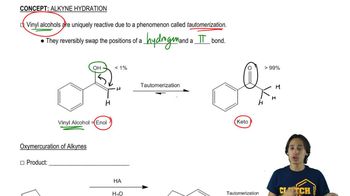
Alkyne Hydration

Hydrogenation

Hydrogenation is a chemical reaction that involves the addition of hydrogen (H2) to a compound, typically in the presence of a catalyst. This process is commonly used to convert unsaturated hydrocarbons, such as alkynes and alkenes, into saturated hydrocarbons. The catalyst, such as Raney nickel, facilitates the reaction by lowering the activation energy required for the hydrogen to add across the multiple bonds.
Recommended video:
Guided course
00:48
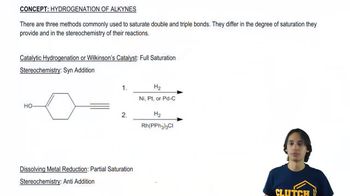
The definition of hydrogenation.

Raney Nickel Catalyst

Raney nickel is a finely divided nickel-aluminum alloy that serves as a catalyst in hydrogenation reactions. It is particularly effective for reducing alkynes and alkenes to alkanes. The high surface area of Raney nickel enhances its catalytic activity, allowing for efficient hydrogenation under mild conditions, making it a valuable tool in organic synthesis.
Recommended video:
Guided course
03:17
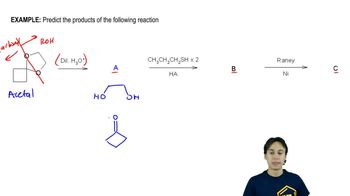
Raney Nickel Reduction