Ch. 16 - Reactions of Aldehydes and Ketones • More Reactions of Carboxylic Acid Derivatives
Bruice - Organic Chemistry 8th Edition
Bruice8th EditionOrganic ChemistryISBN: 9780135213711Not the one you use?Change textbook
Chapter 17, Problem 54e

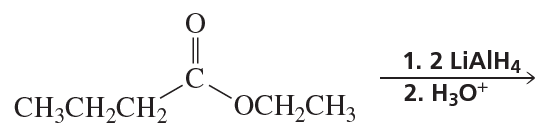
What are the products of the following reactions?
e. Chemical structure of an acetal with reaction steps involving lithium aluminum hydride and water.

Verified step by step guidance
1
Step 1: Identify the functional groups in the reactants. The starting material is an aldehyde (CH3CH2CHO), and methanol (CH3OH) is the alcohol reagent. HCl is the acid catalyst.
Step 2: Recognize the reaction type. This is an acid-catalyzed nucleophilic addition reaction, specifically the formation of a hemiacetal or acetal depending on the conditions. Since methanol is in excess, the reaction will likely proceed to form an acetal.
Step 3: Understand the mechanism. The aldehyde carbonyl group is protonated by HCl, increasing its electrophilicity. Methanol then acts as a nucleophile, attacking the carbonyl carbon to form a tetrahedral intermediate.
Step 4: The intermediate loses water, forming a methoxy group (-OCH3). A second molecule of methanol attacks the carbonyl carbon, leading to the formation of a second methoxy group (-OCH3). This results in the acetal product.
Step 5: Write the final product structure. The acetal product will have two methoxy groups (-OCH3) attached to the original carbonyl carbon, replacing the aldehyde functional group. The structure will be CH3CH2C(OCH3)2.

Verified video answer for a similar problem:

This video solution was recommended by our tutors as helpful for the problem above.
Video duration:
2m
Was this helpful?

Key Concepts

Here are the essential concepts you must grasp in order to answer the question correctly.

Aldehyde Reactivity

Aldehydes are highly reactive carbonyl compounds characterized by the presence of a carbonyl group (C=O) bonded to at least one hydrogen atom. This reactivity allows them to undergo various nucleophilic addition reactions, including the formation of acetals when reacted with alcohols in the presence of an acid catalyst.
Recommended video:
Guided course
01:34
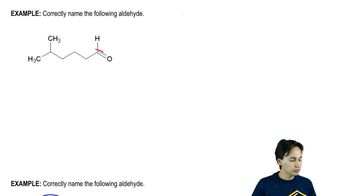
Name the aldehyde

Acetal Formation

Acetals are formed when an aldehyde reacts with an alcohol in the presence of an acid catalyst, such as HCl. The reaction involves the nucleophilic attack of the alcohol on the carbonyl carbon, followed by the elimination of water and the formation of a stable acetal structure, which consists of two alkoxy groups attached to the same carbon atom.
Recommended video:
Guided course
04:29
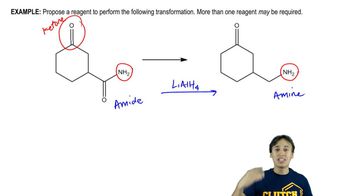
Acetal Protecting Group

Role of Acid Catalyst

An acid catalyst, like HCl, is crucial in the acetal formation process as it protonates the carbonyl oxygen, increasing the electrophilicity of the carbonyl carbon. This enhances the nucleophilic attack by the alcohol, facilitating the reaction and driving it towards the formation of the acetal product, especially when excess alcohol is present.
Recommended video:
2:50
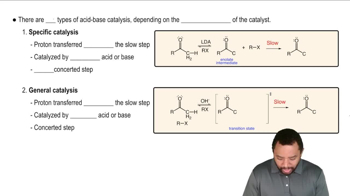
Acid-Base Catalysis Concept 3