Ch. 16 - Reactions of Aldehydes and Ketones • More Reactions of Carboxylic Acid Derivatives
Bruice - Organic Chemistry 8th Edition
Bruice8th EditionOrganic ChemistryISBN: 9780135213711Not the one you use?Change textbook
Chapter 17, Problem 22

What amides would you react with LiAlH4 to form the following amines?
a. benzylmethylamine
b. ethylamine
c. diethylamine
d. triethylamine

Verified step by step guidance
1
Identify the general reaction mechanism: Lithium aluminum hydride (LiAlH4) is a strong reducing agent that reduces amides to their corresponding amines. The carbonyl group (C=O) in the amide is reduced to a methylene group (-CH2-), and the nitrogen remains attached to the carbon chain.
For benzylmethylamine: Determine the amide precursor. The amide must have a benzyl group (C6H5-CH2-) attached to the carbonyl carbon and a methyl group (-CH3) attached to the nitrogen. The structure of the amide would be benzylmethylamide (C6H5-CH2-CONHCH3).
For ethylamine: Determine the amide precursor. The amide must have an ethyl group (-CH2CH3) attached to the carbonyl carbon and a single hydrogen attached to the nitrogen. The structure of the amide would be ethanamide (CH3CONH2).
For diethylamine: Determine the amide precursor. The amide must have an ethyl group (-CH2CH3) attached to the carbonyl carbon and an ethyl group attached to the nitrogen. The structure of the amide would be N-ethylacetamide (CH3CONHCH2CH3).
For triethylamine: Note that triethylamine cannot be synthesized by reducing an amide with LiAlH4. This is because the reaction mechanism involves the reduction of the carbonyl group, and triethylamine lacks a carbonyl group in its structure. Triethylamine is typically synthesized through other methods, such as alkylation of ammonia or amines.

Verified video answer for a similar problem:

This video solution was recommended by our tutors as helpful for the problem above.
Video duration:
4m
Was this helpful?

Key Concepts

Here are the essential concepts you must grasp in order to answer the question correctly.

Reduction of Amides

Amides can be reduced to amines using reducing agents like lithium aluminum hydride (LiAlH4). This reaction involves the addition of hydride ions to the carbonyl carbon of the amide, leading to the formation of an intermediate that subsequently transforms into an amine. Understanding the mechanism of this reduction is crucial for predicting the products formed.
Recommended video:
Guided course
01:33
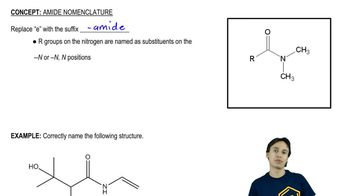
Amide Nomenclature

Structure of Amides

Amides are characterized by the functional group -C(=O)NR2, where R can be hydrogen or hydrocarbon groups. The structure of the amide influences its reactivity and the type of amine produced upon reduction. Recognizing the specific amide structures that correspond to the desired amines is essential for solving the question.
Recommended video:
Guided course
01:33
Amide Nomenclature

Types of Amines

Amines are classified into primary, secondary, and tertiary based on the number of carbon groups attached to the nitrogen atom. The type of amine formed from the reduction of an amide will depend on the structure of the starting amide. Identifying whether the target amine is primary, secondary, or tertiary helps in determining the appropriate amide to use in the reaction.
Recommended video:
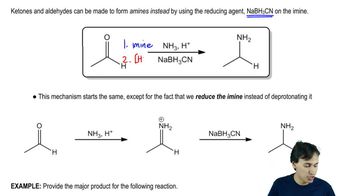
Guided course
07:12
Reductive Amination