Ch. 16 - Reactions of Aldehydes and Ketones • More Reactions of Carboxylic Acid Derivatives
Bruice - Organic Chemistry 8th Edition
Bruice8th EditionOrganic ChemistryISBN: 9780135213711Not the one you use?Change textbook
Chapter 17, Problem 23a

How would you make the following compounds from N-benzylbenzamide?
a. dibenzylamine

Verified step by step guidance
1
Step 1: Analyze the starting material, N-benzylbenzamide. It contains an amide functional group (-CONH-) attached to a benzyl group and a benzene ring.
Step 2: Recognize that the target compound, dibenzylamine, requires the removal of the carbonyl group from the amide to yield a secondary amine with two benzyl groups attached to the nitrogen.
Step 3: Plan the reaction. To convert an amide to an amine, a reduction reaction is required. Use a strong reducing agent such as lithium aluminum hydride (LiAlH₄), which is effective for reducing amides to amines.
Step 4: Perform the reduction. Treat N-benzylbenzamide with LiAlH₄ in an appropriate solvent like dry ether. This will reduce the amide group to a secondary amine, resulting in dibenzylamine.
Step 5: Purify the product. After the reaction is complete, quench the excess LiAlH₄ carefully with water or an alcohol, and then isolate dibenzylamine using techniques such as extraction and distillation.

Verified video answer for a similar problem:

This video solution was recommended by our tutors as helpful for the problem above.
Video duration:
3m
Was this helpful?

Key Concepts

Here are the essential concepts you must grasp in order to answer the question correctly.

N-benzylbenzamide Structure

N-benzylbenzamide is an amide compound where a benzyl group is attached to the nitrogen of a benzamide. Understanding its structure is crucial for recognizing how it can be transformed into other compounds, such as dibenzylamine, through chemical reactions that involve the amide functional group.
Recommended video:
1:48
Synthesis of Amino Acids: N-Phthalimidomalonic Ester Synthesis Example 1

Reduction Reactions

Reduction reactions involve the gain of electrons or the decrease in oxidation state, often resulting in the conversion of carbonyl groups (like those in amides) to amines. In the case of N-benzylbenzamide, a reduction reaction can convert the amide into dibenzylamine by removing the carbonyl oxygen and adding hydrogen.
Recommended video:
Guided course
07:12
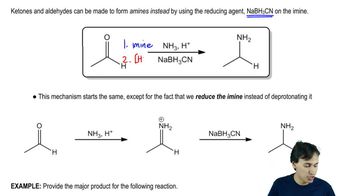
Reductive Amination

Dibenzylamine Formation

Dibenzylamine is a secondary amine formed by the reaction of N-benzylbenzamide with a reducing agent. This compound features two benzyl groups attached to a nitrogen atom, and understanding its formation is essential for grasping the transformation process from the starting amide compound.
Recommended video:
Guided course
02:26
Formation of Enolates