Ch. 16 - Reactions of Aldehydes and Ketones • More Reactions of Carboxylic Acid Derivatives
Bruice - Organic Chemistry 8th Edition
Bruice8th EditionOrganic ChemistryISBN: 9780135213711Not the one you use?Change textbook
Chapter 17, Problem 68a

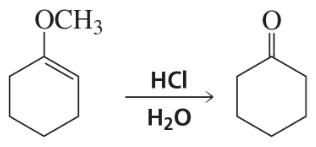
Propose a mechanism for each of the following reactions:
a.

Verified step by step guidance
1
Identify the type of reaction taking place. For example, determine if it is a substitution, addition, elimination, or rearrangement reaction. This will guide the mechanism you propose.
Examine the structure of the reactants and identify any functional groups that are likely to participate in the reaction. Look for nucleophiles, electrophiles, and leaving groups.
Determine the first step of the mechanism. Often, this involves the formation of a reactive intermediate, such as a carbocation, carbanion, or radical. Consider how the electrons will move to form this intermediate.
Propose the subsequent steps of the mechanism, ensuring that each step follows logically from the previous one. Pay attention to the movement of electrons, which can be shown using curved arrows to indicate the flow from electron-rich to electron-poor areas.
Consider any possible rearrangements or side reactions that might occur, and ensure that the final product is consistent with the reaction conditions and the starting materials. Double-check that all atoms and charges are balanced throughout the mechanism.

Verified video answer for a similar problem:

This video solution was recommended by our tutors as helpful for the problem above.
Video duration:
8m
Was this helpful?

Key Concepts

Here are the essential concepts you must grasp in order to answer the question correctly.

Reaction Mechanisms

A reaction mechanism is a step-by-step description of how a chemical reaction occurs at the molecular level. It outlines the sequence of elementary steps, including bond breaking and formation, and the intermediates formed during the reaction. Understanding mechanisms is crucial for predicting the products and understanding the kinetics and thermodynamics of the reaction.
Recommended video:
Guided course
02:16
Heck Reaction Mechanism

Types of Organic Reactions

Organic reactions can be classified into several types, including substitution, addition, elimination, and rearrangement reactions. Each type has distinct characteristics and mechanisms. Recognizing the type of reaction helps in predicting the behavior of reactants and the nature of the products formed, which is essential for proposing accurate mechanisms.
Recommended video:
Guided course
07:37
Properties and Types of Pericyclic Reactions

Curved Arrow Notation

Curved arrow notation is a visual representation used in organic chemistry to depict the movement of electrons during a reaction. Arrows indicate the direction of electron flow, showing how bonds are broken and formed. Mastery of this notation is vital for illustrating reaction mechanisms clearly and accurately, allowing for better understanding and communication of chemical processes.
Recommended video:
Guided course
06:20
Alternative MO Notation for Dienes