Ch. 15 - Reactions of Carboxylic Acids and Carboxylic Acid Derivatives
Bruice - Organic Chemistry 8th Edition
Bruice8th EditionOrganic ChemistryISBN: 9780135213711Not the one you use?Change textbook
Chapter 15, Problem 50g,h

What compounds are formed from the reaction of benzoyl chloride with the following reagents?
g. excess benzylamine
h. 4-chlorophenol

Verified step by step guidance
1
Identify the functional group in benzoyl chloride. Benzoyl chloride contains an acyl chloride group (-COCl), which is highly reactive and undergoes nucleophilic acyl substitution reactions.
Understand the reaction mechanism with benzylamine (excess). Benzylamine (C6H5CH2NH2) is a nucleophile that will attack the carbonyl carbon of benzoyl chloride. The reaction proceeds via a nucleophilic acyl substitution mechanism, where the amine replaces the chloride ion (Cl⁻) to form a benzamide derivative.
Write the general reaction for part (g): \( \text{C6H5COCl} + \text{C6H5CH2NH2} \rightarrow \text{C6H5CONHCH2C6H5} + \text{HCl} \). Since benzylamine is in excess, it can also neutralize the HCl formed during the reaction, preventing side reactions.
Understand the reaction mechanism with 4-chlorophenol. 4-Chlorophenol (C6H4ClOH) is a phenol derivative, and the hydroxyl group (-OH) acts as a nucleophile. It will attack the carbonyl carbon of benzoyl chloride, replacing the chloride ion (Cl⁻) to form an ester.
Write the general reaction for part (h): \( \text{C6H5COCl} + \text{C6H4ClOH} \rightarrow \text{C6H5COOC6H4Cl} + \text{HCl} \). The product is an ester (benzoyl-4-chlorophenyl ester), and HCl is released as a byproduct.

Verified video answer for a similar problem:

This video solution was recommended by our tutors as helpful for the problem above.
Video duration:
5m

Key Concepts

Here are the essential concepts you must grasp in order to answer the question correctly.

Acyl Chlorides

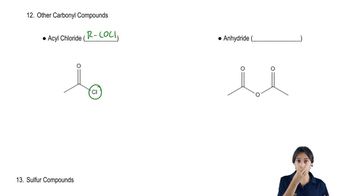
Acyl chlorides, such as benzoyl chloride, are reactive compounds containing a carbonyl group (C=O) bonded to a chlorine atom. They are known for their ability to undergo nucleophilic acyl substitution reactions, where the chlorine atom is replaced by a nucleophile. Understanding the reactivity of acyl chlorides is crucial for predicting the products formed when they react with various nucleophiles.
Recommended video:
01:57
Recognizing acyl chlorides and anhydrides.

Nucleophilic Substitution

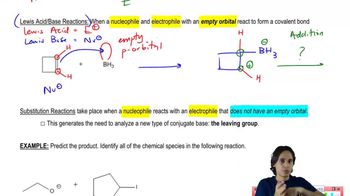
Nucleophilic substitution is a fundamental reaction mechanism in organic chemistry where a nucleophile attacks an electrophilic carbon atom, leading to the replacement of a leaving group. In the case of benzoyl chloride, nucleophiles like benzylamine and 4-chlorophenol can attack the carbonyl carbon, resulting in the formation of amides or esters, respectively. This concept is essential for understanding how different reagents interact with acyl chlorides.
Recommended video:
01:47
Nucleophiles and Electrophiles can react in Substitution Reactions.

Amide Formation

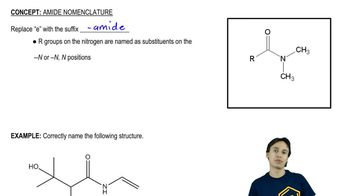
Amide formation occurs when an acyl chloride reacts with an amine, resulting in the creation of an amide bond (C=O-N). In the reaction with excess benzylamine, benzoyl chloride will yield N-benzoylbenzylamine, showcasing the transformation of the acyl chloride into a more stable amide. This process is significant in organic synthesis, as amides are important functional groups in various chemical compounds.
Recommended video:
01:33
Amide Nomenclature