Ch. 15 - Reactions of Carboxylic Acids and Carboxylic Acid Derivatives
Bruice - Organic Chemistry 8th Edition
Bruice8th EditionOrganic ChemistryISBN: 9780135213711Not the one you use?Change textbook
Chapter 16, Problem 50e

What compounds are formed from the reaction of benzoyl chloride with the following reagents?
e. aqueous NaOH

Verified step by step guidance
1
Identify the functional group in benzoyl chloride. Benzoyl chloride contains an acyl chloride group (-COCl), which is highly reactive and undergoes nucleophilic acyl substitution reactions.
Understand the role of aqueous NaOH. Sodium hydroxide (NaOH) is a strong base and nucleophile. In aqueous solution, it provides hydroxide ions (OH⁻), which act as the nucleophile in this reaction.
Determine the mechanism of the reaction. The hydroxide ion attacks the carbonyl carbon of the benzoyl chloride, which is electrophilic due to the electron-withdrawing effect of the chlorine atom and the carbonyl group. This forms a tetrahedral intermediate.
Analyze the fate of the tetrahedral intermediate. The intermediate collapses, expelling the chloride ion (Cl⁻) as a leaving group and forming a new carbon-oxygen double bond.
Identify the final product. The reaction results in the formation of benzoic acid (C₆H₅COOH) as the hydroxide ion replaces the chlorine atom in benzoyl chloride.

Verified video answer for a similar problem:

This video solution was recommended by our tutors as helpful for the problem above.
Video duration:
2m
Was this helpful?

Key Concepts

Here are the essential concepts you must grasp in order to answer the question correctly.

Benzoyl Chloride

Benzoyl chloride is an acyl chloride derived from benzoic acid. It is a reactive compound that can undergo nucleophilic acyl substitution reactions. In the presence of nucleophiles, such as alcohols or amines, benzoyl chloride can form esters or amides, respectively. Understanding its reactivity is crucial for predicting the products of its reactions.
Recommended video:
Guided course
03:13
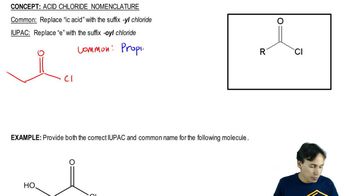
Acid Chloride Nomenclature

Nucleophilic Acyl Substitution

Nucleophilic acyl substitution is a fundamental reaction mechanism in organic chemistry where a nucleophile attacks the carbonyl carbon of an acyl compound, leading to the substitution of a leaving group. In the case of benzoyl chloride reacting with aqueous NaOH, hydroxide ions act as the nucleophile, resulting in the formation of benzoic acid. This mechanism is essential for understanding how acyl chlorides react with various nucleophiles.
Recommended video:
Guided course
01:47
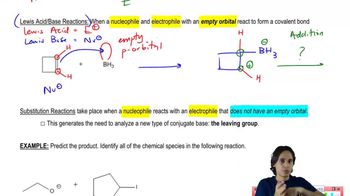
Nucleophiles and Electrophiles can react in Substitution Reactions.

Hydrolysis of Acyl Chlorides

Hydrolysis of acyl chlorides involves the reaction of the acyl chloride with water or aqueous solutions, leading to the formation of carboxylic acids. In this specific reaction with aqueous NaOH, the hydroxide ions facilitate the hydrolysis process, converting benzoyl chloride into benzoic acid and sodium chloride. This concept is vital for predicting the outcome of reactions involving acyl chlorides in aqueous environments.
Recommended video:
Guided course
01:57
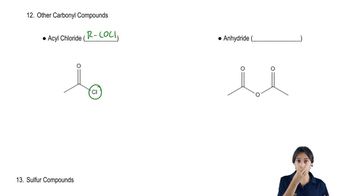
Recognizing acyl chlorides and anhydrides.