

Ch. 15 - Reactions of Carboxylic Acids and Carboxylic Acid Derivatives
Bruice - Organic Chemistry 8th Edition
Bruice8th EditionOrganic ChemistryISBN: 9780135213711Not the one you use?Change textbook
Chapter 16, Problem 81b

Cardura, a drug used to treat hypertension, is synthesized as shown here.
Chemical reaction diagram illustrating the synthesis of Cardura, highlighting intermediate A and the reaction mechanism.
b. Show the mechanism for conversion of A to B. Which is formed more rapidly, A or B?

Verified step by step guidance
1
Step 1: Begin by analyzing the reaction from A to B. The conversion involves the use of KOH, which is a strong base. This suggests that the reaction mechanism likely involves deprotonation or nucleophilic substitution.
Step 2: Identify the functional groups in compound A. Look for reactive sites such as hydroxyl groups, halides, or acidic hydrogens that could interact with KOH.
Step 3: Propose the mechanism. If compound A contains an acidic hydrogen, KOH will deprotonate it, forming a negatively charged intermediate. Alternatively, if A contains a halide, KOH could act as a nucleophile, displacing the halide via an SN2 mechanism.
Step 4: Compare the formation rates of A and B. The rate of formation depends on the stability of the intermediates and the activation energy of the reaction. Typically, the compound with a more stable intermediate or lower activation energy will form more rapidly.
Step 5: Consider steric and electronic effects. If compound B is sterically hindered or electronically less favorable, it may form more slowly than A. Conversely, if B is stabilized by resonance or other factors, it may form more rapidly.

Verified video answer for a similar problem:

This video solution was recommended by our tutors as helpful for the problem above.
Video duration:
6m
Was this helpful?

Key Concepts

Here are the essential concepts you must grasp in order to answer the question correctly.

Nucleophilic Substitution Mechanism

Nucleophilic substitution is a fundamental reaction in organic chemistry where a nucleophile attacks an electrophile, replacing a leaving group. This mechanism can occur via two main pathways: SN1, which involves a two-step process with a carbocation intermediate, and SN2, which is a one-step process where the nucleophile attacks the electrophile simultaneously as the leaving group departs. Understanding this mechanism is crucial for analyzing the conversion of compound A to B.
Recommended video:
Guided course
01:47
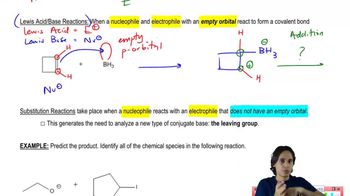
Nucleophiles and Electrophiles can react in Substitution Reactions.

Reaction Conditions and Their Effects

The conditions under which a reaction occurs, such as temperature, solvent, and the presence of catalysts, significantly influence the rate and outcome of chemical reactions. In the case of converting A to B, the use of KOH suggests a strong base that can facilitate deprotonation or promote nucleophilic attack. Recognizing how these conditions affect the reaction pathway helps in predicting which compound forms more rapidly.
Recommended video:
3:26
Directing Effects in Substituted Pyrroles, Furans, and Thiophenes Concept 2

Kinetics of Reaction

Reaction kinetics studies the rates of chemical reactions and the factors that influence them. The rate of formation of products A and B can be determined by analyzing the energy barriers and transition states involved in their formation. In this context, understanding the kinetics will help determine which compound is formed more rapidly, providing insight into the efficiency of the synthesis process.
Recommended video:
Guided course
08:51
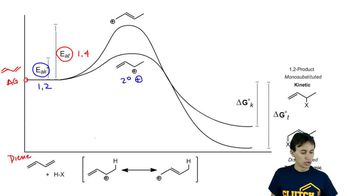
Kinetic vs. Thermodynamic Control