

Ch. 15 - Reactions of Carboxylic Acids and Carboxylic Acid Derivatives
Bruice - Organic Chemistry 8th Edition
Bruice8th EditionOrganic ChemistryISBN: 9780135213711Not the one you use?Change textbook
Chapter 16, Problem 81a

Cardura, a drug used to treat hypertension, is synthesized as shown here.
Chemical reaction diagram illustrating the synthesis of Cardura, highlighting intermediate A and the reaction mechanism.
a. Identify the intermediate (A) and show the mechanism for its formation.

Verified step by step guidance
1
Step 1: Analyze the reaction sequence. The first step involves the use of potassium carbonate (K₂CO₃), which is a base. This suggests that the reaction may involve deprotonation or nucleophilic substitution.
Step 2: Identify the starting materials and their functional groups. Look for reactive sites such as halides, hydroxyl groups, or acidic hydrogens that could interact with K₂CO₃.
Step 3: Propose the mechanism for the formation of intermediate A. If the starting material contains an acidic hydrogen (e.g., an alcohol or phenol group), K₂CO₃ can deprotonate it to form an alkoxide ion. Represent this step using the equation: ROH+K2CO3RO-+K2HCO3
Step 4: Consider the role of the alkoxide ion formed. Alkoxide ions are strong nucleophiles and can participate in substitution reactions if an electrophilic site (e.g., an alkyl halide) is present in the starting material. This would lead to the formation of intermediate A.
Step 5: Write the structure of intermediate A based on the substitution reaction. Ensure that the mechanism accounts for the formation of A and aligns with the subsequent steps in the synthesis of Cardura.

Verified video answer for a similar problem:

This video solution was recommended by our tutors as helpful for the problem above.
Video duration:
5m
Was this helpful?

Key Concepts

Here are the essential concepts you must grasp in order to answer the question correctly.

Reaction Mechanism

A reaction mechanism is a step-by-step description of how reactants transform into products in a chemical reaction. It outlines the individual steps, including bond breaking and forming, and the intermediates involved. Understanding the mechanism is crucial for predicting the outcome of reactions and for identifying intermediates like compound A in the synthesis of Cardura.
Recommended video:
Guided course
02:16
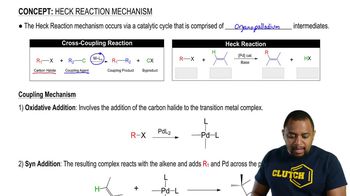
Heck Reaction Mechanism

Intermediates

Intermediates are species that are formed during the course of a chemical reaction but are not present in the final products. They are often unstable and exist only for a short duration. Identifying intermediates is essential for understanding the overall reaction pathway and for elucidating the mechanism of synthesis, as seen in the formation of compound A in the synthesis of Cardura.
Recommended video:
Guided course
04:31
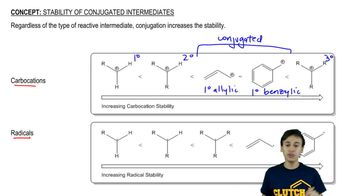
Stability of Conjugated Intermediates

Nucleophilic Substitution

Nucleophilic substitution is a fundamental reaction type in organic chemistry where a nucleophile attacks an electrophile, resulting in the replacement of a leaving group. This process is key in the formation of many organic compounds, including intermediates. In the context of Cardura's synthesis, understanding nucleophilic substitution helps explain how compound A is formed and subsequently transformed into the final product.
Recommended video:
Guided course
01:47
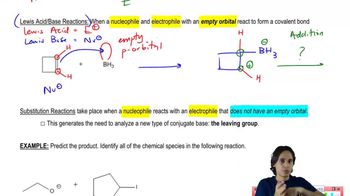
Nucleophiles and Electrophiles can react in Substitution Reactions.