Ch. 15 - Reactions of Carboxylic Acids and Carboxylic Acid Derivatives
Bruice - Organic Chemistry 8th Edition
Bruice8th EditionOrganic ChemistryISBN: 9780135213711Not the one you use?Change textbook
Chapter 16, Problem 61

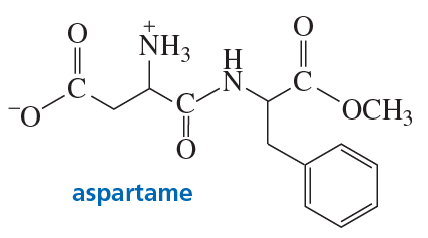
Aspartame, the sweetener used in the commercial products NutraSweet and Equal, is 200 times sweeter than sucrose. What products will be obtained if aspartame is hydrolyzed completely in an aqueous solution of HCl?
Chemical structure of aspartame, a sweetener, labeled with its name in blue text.

Verified step by step guidance
1
Identify the functional groups in the structure of aspartame. Aspartame contains ester groups, amide groups, and a carboxylic acid group. These are susceptible to hydrolysis under acidic conditions.
Understand the mechanism of hydrolysis in acidic conditions. Ester groups hydrolyze to form alcohols and carboxylic acids, while amide groups hydrolyze to form carboxylic acids and amines.
Focus on the ester bond in aspartame. The ester bond between the phenylalanine residue and the methyl group will hydrolyze to produce methanol and phenylalanine.
Examine the amide bond in aspartame. The amide bond between phenylalanine and aspartic acid will hydrolyze to produce phenylalanine and aspartic acid.
Combine the products from the hydrolysis reactions. The complete hydrolysis of aspartame in aqueous HCl will yield methanol, phenylalanine, and aspartic acid as the final products.

Verified video answer for a similar problem:

This video solution was recommended by our tutors as helpful for the problem above.
Video duration:
6m
Was this helpful?

Key Concepts

Here are the essential concepts you must grasp in order to answer the question correctly.

Hydrolysis

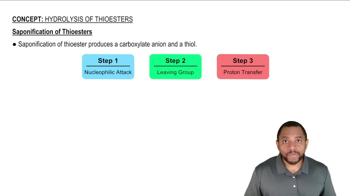
Hydrolysis is a chemical reaction involving the breaking of a bond in a molecule using water. In the context of organic compounds, hydrolysis often involves the cleavage of ester or amide bonds, leading to the formation of acids and alcohols or amines. For aspartame, hydrolysis will break it down into its constituent amino acids and methanol when treated with an acid like HCl.
Recommended video:
1:00
Hydrolysis of Thioesters Concept 2

Aspartame Structure

Aspartame is a dipeptide methyl ester composed of two amino acids: aspartic acid and phenylalanine. Its structure includes an ester bond and a methyl group, which contribute to its sweetness. Understanding its structure is crucial for predicting the products of hydrolysis, as the reaction will yield the free amino acids and methanol upon complete hydrolysis.
Recommended video:
Guided course
03:04
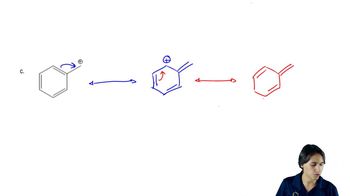
Drawing Resonance Structures

Acid-Catalyzed Reactions

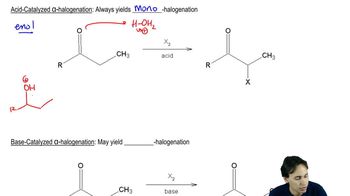
Acid-catalyzed reactions involve the use of an acid to increase the rate of a chemical reaction. In the case of aspartame hydrolysis in an aqueous HCl solution, the acid facilitates the breakdown of the peptide bond and ester bond, leading to the formation of the products. This concept is essential for understanding how the reaction proceeds and the conditions required for complete hydrolysis.
Recommended video:
Guided course
03:09
Acid Catalyzed