Ch. 15 - Reactions of Carboxylic Acids and Carboxylic Acid Derivatives
Bruice - Organic Chemistry 8th Edition
Bruice8th EditionOrganic ChemistryISBN: 9780135213711Not the one you use?Change textbook
Chapter 16, Problem 60

A compound with molecular formula C5H10O2 gives the following IR spectrum. When it undergoes acid-catalyzed hydrolysis, the compound with the 1H NMR spectrum shown below is formed. Identify the compounds.
<IMAGE>

Verified step by step guidance
1
Analyze the molecular formula (C5H10O2): This suggests the compound is likely a carboxylic acid derivative (e.g., ester, acid anhydride, etc.) due to the presence of two oxygen atoms and the degree of unsaturation (calculated as 1 double bond equivalent).
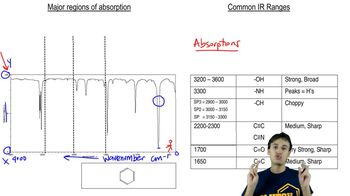
Examine the IR spectrum: Look for characteristic peaks. A strong absorption around 1700 cm⁻¹ indicates the presence of a carbonyl group (C=O). If there is no broad peak around 2500-3300 cm⁻¹, it suggests the absence of a carboxylic acid group, pointing towards an ester or other derivative.
Consider the acid-catalyzed hydrolysis: Hydrolysis of esters in acidic conditions typically produces a carboxylic acid and an alcohol. This reaction provides a clue that the starting compound is likely an ester.
Interpret the 1H NMR spectrum of the hydrolysis product: Look for signals corresponding to a carboxylic acid (a singlet around 10-12 ppm) and other characteristic peaks that can help identify the alcohol or other fragments formed during hydrolysis.
Combine all evidence: Use the molecular formula, IR spectrum, and NMR data to deduce the structure of the starting ester and the hydrolysis products. Ensure the structures are consistent with all provided data and the reaction mechanism.

Verified video answer for a similar problem:

This video solution was recommended by our tutors as helpful for the problem above.
Video duration:
7m
Was this helpful?

Key Concepts

Here are the essential concepts you must grasp in order to answer the question correctly.

Infrared (IR) Spectroscopy

IR spectroscopy is a technique used to identify functional groups in organic compounds by measuring the absorption of infrared light. Different bonds absorb characteristic frequencies of IR radiation, resulting in a spectrum that provides information about the molecular structure. Key peaks in the spectrum can indicate the presence of specific functional groups, such as alcohols, carbonyls, or esters.
Recommended video:
Guided course
16:04
General Features of IR Spect

Nuclear Magnetic Resonance (NMR) Spectroscopy

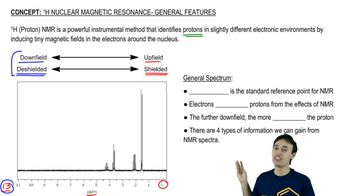
NMR spectroscopy is a powerful analytical technique that provides information about the structure of organic compounds based on the magnetic properties of atomic nuclei. In 1H NMR, the environment of hydrogen atoms is analyzed, revealing details about the number of hydrogen atoms, their connectivity, and the presence of neighboring atoms. This information is crucial for deducing the structure of the compound formed after hydrolysis.
Recommended video:
Guided course
10:06
General NMR Features

Acid-Catalyzed Hydrolysis

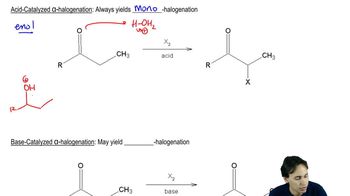
Acid-catalyzed hydrolysis is a chemical reaction where a compound reacts with water in the presence of an acid, leading to the breakdown of the compound into simpler molecules. This process is commonly used to convert esters into their corresponding acids and alcohols. Understanding this reaction is essential for predicting the products formed from the initial compound with the molecular formula C5H10O2.
Recommended video:
Guided course
03:09
Acid Catalyzed