Ch. 14 - NMR Spectroscopy
Bruice - Organic Chemistry 8th Edition
Bruice8th EditionOrganic ChemistryISBN: 9780135213711Not the one you use?Change textbook
Chapter 15, Problem 69d

Sketch the following spectra that would be obtained for 2-chloroethanol:
d. The proton-coupled 13C NMR spectrum.

Verified step by step guidance
1
Identify the structure of 2-chloroethanol (ClCH2CH2OH) and determine the number of unique carbon environments. In this molecule, there are two distinct carbon atoms: one bonded to the chlorine atom (C1) and the other bonded to the hydroxyl group (C2).
Understand that in a proton-coupled 13C NMR spectrum, each carbon signal is split into a multiplet based on the number of directly attached protons. The splitting follows the n+1 rule, where n is the number of protons attached to the carbon.
Analyze the splitting for C1 (the carbon bonded to chlorine). This carbon is directly attached to two protons, so its signal will appear as a triplet (n+1 = 2+1 = 3).
Analyze the splitting for C2 (the carbon bonded to the hydroxyl group). This carbon is directly attached to two protons as well, so its signal will also appear as a triplet (n+1 = 2+1 = 3).
Sketch the spectrum with two signals: one triplet for C1 and another triplet for C2. Ensure the chemical shifts reflect the deshielding effects, with C1 appearing downfield (higher ppm) due to the electronegative chlorine atom, and C2 appearing upfield (lower ppm) relative to C1.

Verified video answer for a similar problem:

This video solution was recommended by our tutors as helpful for the problem above.
Video duration:
7m
Was this helpful?

Key Concepts

Here are the essential concepts you must grasp in order to answer the question correctly.

Nuclear Magnetic Resonance (NMR) Spectroscopy

NMR spectroscopy is a powerful analytical technique used to determine the structure of organic compounds. It exploits the magnetic properties of certain nuclei, such as hydrogen (1H) and carbon (13C), to provide information about the number of atoms, their environment, and connectivity. In proton-coupled 13C NMR, the interactions between protons and carbon atoms are observed, revealing details about the molecular structure.
Recommended video:
Guided course
10:06
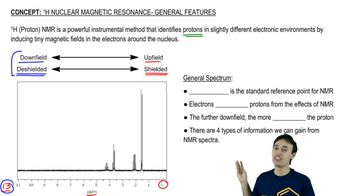
General NMR Features

Chemical Shifts

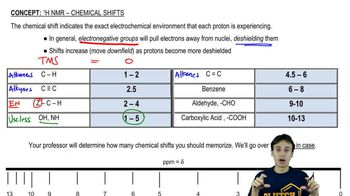
Chemical shifts in NMR spectroscopy refer to the variation in resonance frequency of a nucleus due to its electronic environment. In 13C NMR, chemical shifts are measured in parts per million (ppm) and provide insights into the types of carbon atoms present in a molecule. For 2-chloroethanol, the chemical shifts will reflect the presence of the hydroxyl group and the chlorine atom, influencing the electronic environment of the carbon atoms.
Recommended video:
Guided course
11:44
1H NMR Chemical Shifts

Multiplicity and Coupling Patterns

Multiplicity in NMR refers to the splitting of NMR signals due to spin-spin coupling between neighboring nuclei. In proton-coupled 13C NMR, the number of peaks observed for each carbon signal corresponds to the number of protons on adjacent carbons, following the n+1 rule (where n is the number of neighboring protons). For 2-chloroethanol, the coupling patterns will help identify the connectivity and arrangement of the carbon and hydrogen atoms in the molecule.
Recommended video:
Guided course
03:14
Negishi Coupling Reaction