Ch. 13 - Mass Spectrometry; Infrared Spectroscopy; UV/Vis Spectroscopy
Bruice - Organic Chemistry 8th Edition
Bruice8th EditionOrganic ChemistryISBN: 9780135213711Not the one you use?Change textbook
Chapter 14, Problem 48

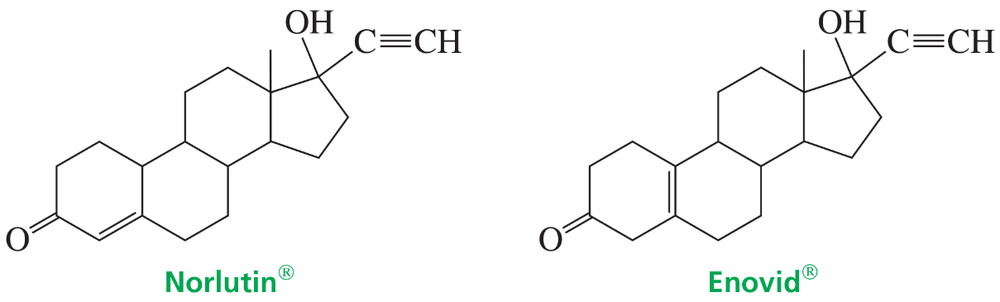
Norlutin and Enovid are ketones that suppress ovulation, so they have been used clinically as contraceptives. For which of these compounds would you expect the infrared carbonyl absorption (C=O stretch) to be at a higher frequency? Explain.

Verified step by step guidance
1
Step 1: Analyze the chemical structures of Norlutin and Enovid. Both compounds contain a ketone functional group (C=O) and other structural features such as hydroxyl groups and alkynes.
Step 2: Understand the factors affecting the infrared absorption frequency of the carbonyl group. The stretching frequency of the C=O bond in IR spectroscopy is influenced by resonance effects, inductive effects, and hydrogen bonding.
Step 3: Compare the resonance effects in Norlutin and Enovid. In Enovid, the ketone is conjugated with a double bond, which allows for resonance delocalization of electrons. This resonance reduces the double bond character of the C=O bond, lowering its stretching frequency.
Step 4: Consider the ketone in Norlutin. The ketone in Norlutin is not conjugated with a double bond, so it retains a stronger double bond character. This results in a higher stretching frequency for the C=O bond in Norlutin compared to Enovid.
Step 5: Conclude that the infrared carbonyl absorption (C=O stretch) would be at a higher frequency for Norlutin than for Enovid due to the lack of resonance stabilization in Norlutin's ketone group.

Verified video answer for a similar problem:

This video solution was recommended by our tutors as helpful for the problem above.
Video duration:
6m
Was this helpful?

Key Concepts

Here are the essential concepts you must grasp in order to answer the question correctly.

Infrared Spectroscopy

Infrared (IR) spectroscopy is a technique used to identify functional groups in organic compounds by measuring the absorption of infrared light. Different bonds absorb IR radiation at characteristic frequencies, allowing chemists to determine the presence of specific functional groups, such as carbonyls (C=O). The position of these absorptions can provide insights into the molecular environment and structure of the compound.
Recommended video:
2:56
The UV-Vis Spectroscopy Concept 1

Carbonyl Group Characteristics

The carbonyl group (C=O) is a functional group found in ketones, aldehydes, and other compounds. The frequency of the C=O stretching vibration in IR spectroscopy is influenced by the electronic environment surrounding the carbonyl carbon. Factors such as steric hindrance, conjugation, and the presence of electron-withdrawing or donating groups can shift the absorption frequency, with more electron-withdrawing groups typically leading to higher frequencies.
Recommended video:
Guided course
03:50
Intro to Carboxylic Acid Derivatives

Steric and Electronic Effects

Steric effects arise from the spatial arrangement of atoms in a molecule, which can influence the reactivity and properties of functional groups. Electronic effects involve the influence of nearby atoms or groups on the electron density of a functional group. In the case of Norlutin and Enovid, the presence of bulky groups or electron-withdrawing substituents can affect the carbonyl absorption frequency, making it essential to analyze these factors when comparing the two compounds.
Recommended video:
Guided course
02:53
Understanding steric effects.