Ch. 13 - Mass Spectrometry; Infrared Spectroscopy; UV/Vis Spectroscopy
Bruice - Organic Chemistry 8th Edition
Bruice8th EditionOrganic ChemistryISBN: 9780135213711Not the one you use?Change textbook
Chapter 14, Problem 52

A compound gives a mass spectrum with essentially only three peaks at m/z = 77 (40%), 112 (100%), and 114 (33%). Identify the compound.

Verified step by step guidance
1
Analyze the mass spectrum data: The peaks at m/z = 77, 112, and 114 represent the molecular ion and possible fragments. The relative intensities (40%, 100%, and 33%) provide clues about the isotopic composition and structure of the compound.
Focus on the molecular ion peaks at m/z = 112 and 114. The presence of two peaks with a 2 m/z difference and a relative intensity ratio of approximately 3:1 suggests the presence of a chlorine atom. Chlorine has two isotopes, 35Cl and 37Cl, with a natural abundance ratio of about 3:1.
Deduce the molecular formula: The molecular ion peak at m/z = 112 corresponds to the compound containing 35Cl, while the peak at m/z = 114 corresponds to the compound containing 37Cl. This indicates the compound likely contains one chlorine atom.
Examine the fragment peak at m/z = 77: This peak is likely a stable aromatic fragment, such as a phenyl group (C₆H₅⁺), which is common in compounds containing benzene rings.
Combine the information: The compound is likely a chlorobenzene derivative, specifically chlorobenzene (C₆H₅Cl), as it matches the observed mass spectrum with a molecular ion at m/z = 112 (C₆H₅⁻³⁵Cl) and 114 (C₆H₅⁻³⁷Cl), and a fragment peak at m/z = 77 (C₆H₅⁺).

Verified video answer for a similar problem:

This video solution was recommended by our tutors as helpful for the problem above.
Video duration:
4m
Was this helpful?

Key Concepts

Here are the essential concepts you must grasp in order to answer the question correctly.

Mass Spectrometry

Mass spectrometry is an analytical technique used to measure the mass-to-charge ratio of ions. It provides information about the molecular weight and structure of compounds by generating a mass spectrum, which displays the abundance of ions at various mass-to-charge (m/z) values. The peaks in the spectrum correspond to different ions, allowing chemists to deduce the molecular composition of the sample.
Recommended video:
Guided course
01:25
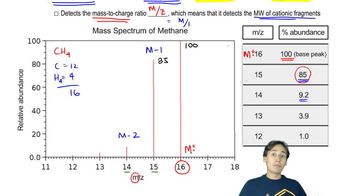
How to Read a Mass Spectrum

Isotopic Patterns

Isotopic patterns arise from the presence of isotopes in elements, which can lead to multiple peaks in a mass spectrum. For example, carbon has isotopes like 12C and 13C, which can create peaks at different m/z values. Understanding these patterns helps in identifying the molecular formula of a compound, as the relative intensities of the peaks can indicate the number of each type of atom present.
Recommended video:
Guided course
08:06
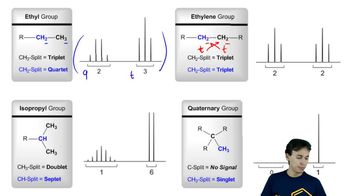
Common Splitting Patterns

Molecular Ion Peak

The molecular ion peak in a mass spectrum represents the intact molecule of the compound being analyzed, typically observed at the highest m/z value. This peak is crucial for determining the molecular weight of the compound. In the given spectrum, the peak at m/z = 112 likely corresponds to the molecular ion, while the other peaks can indicate fragment ions or isotopes, aiding in the identification of the compound.
Recommended video:
3:39
Metal Ion Catalysis Concept 1