Ch. 12 - Radicals
Bruice - Organic Chemistry 8th Edition
Bruice8th EditionOrganic ChemistryISBN: 9780135213711Not the one you use?Change textbook
Chapter 13, Problem 2

Write the steps for formation of tetrachloromethane (CCl4) from the reaction of methane with Cl2 + hv.

Verified step by step guidance
1
Step 1: Understand the reaction mechanism. The reaction of methane (CH4) with chlorine (Cl2) in the presence of ultraviolet light (hv) proceeds via a free radical substitution mechanism. This involves initiation, propagation, and termination steps.
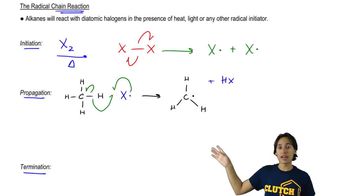
Step 2: Initiation step. UV light (hv) provides energy to break the Cl-Cl bond in chlorine molecules, forming two chlorine radicals (Cl•). This can be represented as: Cl2Cl+Cl
Step 3: Propagation step. A chlorine radical reacts with methane (CH4), abstracting a hydrogen atom to form HCl and a methyl radical (CH3•). This can be represented as: CH4+ClCH3+HCl. The methyl radical then reacts with another Cl2 molecule, forming CH3Cl and another Cl• radical. This process repeats, substituting hydrogen atoms one by one.
Step 4: Continue propagation until all four hydrogen atoms in methane are replaced by chlorine atoms. The successive reactions lead to the formation of dichloromethane (CH2Cl2), trichloromethane (CHCl3), and finally tetrachloromethane (CCl4). Each step involves the abstraction of a hydrogen atom and substitution with a chlorine atom.
Step 5: Termination step. The reaction ends when two radicals combine to form a stable molecule, such as Cl• + Cl• → Cl2 or CH3• + Cl• → CH3Cl. This prevents further propagation and stabilizes the reaction products. The final product, tetrachloromethane (CCl4), is formed after all hydrogen atoms in methane are replaced by chlorine atoms.

Verified video answer for a similar problem:

This video solution was recommended by our tutors as helpful for the problem above.
Video duration:
7m
Was this helpful?

Key Concepts

Here are the essential concepts you must grasp in order to answer the question correctly.

Free Radical Halogenation

Free radical halogenation is a reaction mechanism where alkanes react with halogens in the presence of light (hv) to form alkyl halides. This process involves the generation of free radicals through the homolytic cleavage of the halogen bond, leading to a series of chain reactions that ultimately replace hydrogen atoms in the alkane with halogen atoms.
Recommended video:
Guided course
12:11
Radical Chain Reaction Mechanism.

Mechanism of Chlorination

The chlorination of methane involves three main steps: initiation, propagation, and termination. In the initiation step, Cl2 is dissociated into two chlorine radicals under UV light. During propagation, these radicals react with methane to form chloromethane and additional radicals, which can further react with Cl2, continuing the chain reaction until termination occurs when two radicals combine.
Recommended video:
Guided course
00:48
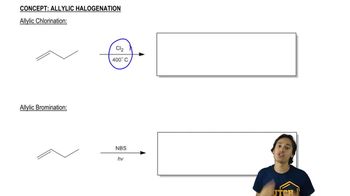
The products of Allylic Chlorination.

Selectivity in Halogenation

Selectivity in halogenation refers to the preference of a halogen to replace certain hydrogen atoms over others in an alkane. In the case of methane, chlorination can lead to multiple products, including chloromethane, dichloromethane, trichloromethane, and tetrachloromethane (CCl4). The formation of CCl4 occurs when all four hydrogen atoms are replaced by chlorine, which is favored under certain conditions, such as excess Cl2.
Recommended video:
Guided course
03:45
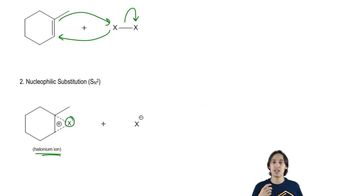
Halogenation Mechanism