Ch. 12 - Radicals
Bruice - Organic Chemistry 8th Edition
Bruice8th EditionOrganic ChemistryISBN: 9780135213711Not the one you use?Change textbook
Chapter 13, Problem 3

a. Which of the hydrogens in the structure in the margin is the easiest for a chlorine radical to remove?
b. How many secondary hydrogens does the structure have?

Verified step by step guidance
1
Step 1: Analyze the structure provided in the margin to identify the types of hydrogens present (primary, secondary, tertiary). Primary hydrogens are attached to a carbon bonded to only one other carbon, secondary hydrogens are attached to a carbon bonded to two other carbons, and tertiary hydrogens are attached to a carbon bonded to three other carbons.
Step 2: For part (a), consider the reactivity of a chlorine radical. Chlorine radicals preferentially abstract hydrogens based on the stability of the resulting carbon radical. Tertiary radicals are the most stable, followed by secondary, and then primary. Identify the hydrogen(s) attached to the carbon that would form the most stable radical upon abstraction.
Step 3: For part (b), count the number of secondary hydrogens in the structure. Secondary hydrogens are those attached to secondary carbons (carbons bonded to two other carbons). Carefully examine the structure and count all such hydrogens.
Step 4: Verify your count of secondary hydrogens by double-checking the structure to ensure no hydrogens are missed or misclassified. Ensure that you correctly distinguish between primary, secondary, and tertiary hydrogens.
Step 5: Summarize your findings: (a) Identify the easiest hydrogen for a chlorine radical to remove based on the stability of the resulting radical, and (b) provide the total number of secondary hydrogens in the structure.

Verified video answer for a similar problem:

This video solution was recommended by our tutors as helpful for the problem above.
Video duration:
3m
Was this helpful?

Key Concepts

Here are the essential concepts you must grasp in order to answer the question correctly.

Radical Stability

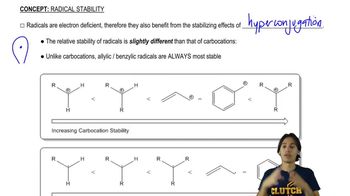
In organic chemistry, the stability of radicals is crucial for understanding reactivity. Chlorine radicals are more likely to remove hydrogens from less stable positions, such as tertiary or secondary carbons, due to the stability of the resulting radical. The more substituted the carbon atom, the more stable the radical formed after hydrogen removal, influencing the ease of hydrogen abstraction.
Recommended video:
Guided course
03:43
The radical stability trend.

Types of Hydrogens

Hydrogens in organic compounds can be classified based on the type of carbon they are attached to: primary, secondary, tertiary, or quaternary. Primary hydrogens are attached to primary carbons, secondary hydrogens to secondary carbons, and so on. This classification is essential for determining the reactivity of hydrogens in radical reactions, as different types of hydrogens exhibit varying levels of reactivity.
Recommended video:
Guided course
00:48
The definition of hydrogenation.

Secondary Hydrogens

Secondary hydrogens are those attached to secondary carbon atoms, which are bonded to two other carbon atoms. Identifying the number of secondary hydrogens in a structure is important for understanding its reactivity and potential sites for radical substitution. This concept is particularly relevant in reactions involving halogenation, where the type and number of hydrogens can influence the outcome of the reaction.
Recommended video:
1:50
Secondary Protein Structure Concept 1