Ch. 12 - Radicals
Bruice - Organic Chemistry 8th Edition
Bruice8th EditionOrganic ChemistryISBN: 9780135213711Not the one you use?Change textbook
Chapter 13, Problem 23d

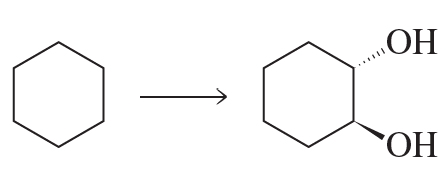
Design a multistep synthesis to show how the following compounds can be prepared from the given starting material:
d. Chemical reaction diagram showing the conversion of a cyclohexane to a diol with hydroxyl groups.

Verified step by step guidance
1
Step 1: Begin with cyclopentane as the starting material. Perform a free radical bromination using Br₂ and light (hv) to introduce a bromine atom at one of the carbons in the cyclopentane ring, forming bromocyclopentane.
Step 2: Convert bromocyclopentane into cyclopentanol by performing a nucleophilic substitution reaction (SN2) using aqueous NaOH. This replaces the bromine atom with a hydroxyl group.
Step 3: Oxidize cyclopentanol to cyclopentanone using an oxidizing agent such as PCC (Pyridinium Chlorochromate) or Jones reagent. This step introduces a ketone functional group.
Step 4: Perform a stereoselective addition of a hydroxyl group to the cyclopentanone using a reagent like OsO₄ (osmium tetroxide) or KMnO₄ under dihydroxylation conditions. This step adds two hydroxyl groups across the double bond in a syn fashion.
Step 5: Ensure the stereochemistry of the final product matches the target compound by carefully controlling the reaction conditions during the dihydroxylation step to achieve the desired cis-diol configuration.

Verified video answer for a similar problem:

This video solution was recommended by our tutors as helpful for the problem above.
Video duration:
8m
Was this helpful?

Key Concepts

Here are the essential concepts you must grasp in order to answer the question correctly.

Radical Reactions

Radical reactions involve species with unpaired electrons, known as radicals. These reactions typically proceed through three main steps: initiation, propagation, and termination. In the context of organic synthesis, radicals can be generated from stable molecules and can react with other compounds to form new bonds, leading to the desired products. Understanding the mechanisms of radical formation and reactivity is crucial for designing effective synthetic pathways.
Recommended video:
Guided course
03:49
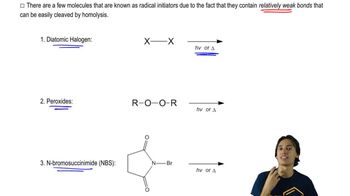
What are Radical Initiators?

Hydroxylation

Hydroxylation is the introduction of hydroxyl (-OH) groups into organic compounds, which can significantly alter their chemical properties and reactivity. This process can occur through various mechanisms, including radical pathways, where a radical species adds to a double bond or an existing radical site. Hydroxylation is essential in organic synthesis for creating alcohols, which are versatile intermediates in further chemical transformations.
Recommended video:
Guided course
01:47
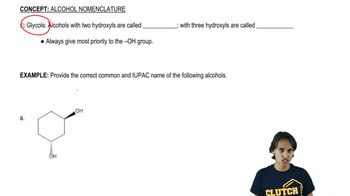
How to name polyols.

Multistep Synthesis

Multistep synthesis refers to the process of constructing complex organic molecules through a series of sequential reactions. Each step typically involves the transformation of starting materials into intermediates, which are then converted into the final product. This approach allows chemists to build intricate structures by strategically planning each reaction, considering factors such as yield, selectivity, and functional group compatibility. Mastery of multistep synthesis is vital for effective organic chemistry.
Recommended video:
Guided course
02:15
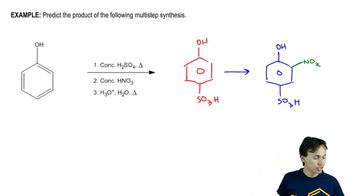
Multistep Synthesis